


Best Speech-to-Text APIs 2026 | MLAI Digital
Prerna Sahni
AI Tools
Introduction
Voice technology is rapidly changing how people interact with digital systems. From voice assistants and automated meeting notes to customer support automation, voice-driven interfaces are becoming a core part of modern applications. At the center of these systems are speech-to-text APIs, which allow machines to convert spoken language into written text.
In recent years, the demand for speech recognition APIs has increased significantly. Businesses now rely on voice technologies to automate processes, analyze customer conversations, and improve accessibility for users. These systems are used to transcribe meetings, generate subtitles for videos, process customer calls, and power conversational AI platforms.
A voice to text API allows developers to integrate speech recognition capabilities into websites, mobile apps, and enterprise software. With a simple API integration, applications can process audio recordings or live speech and convert them into text automatically.
However, choosing the right speech-to-text APIs is important. Different providers offer different levels of speech-to-text API accuracy, language support, pricing models, and real-time processing capabilities.
This guide explores the best speech-to-text APIs in 2026, explaining how they work, their features, pricing models, and real-world applications.
1. What Are Speech-to-Text APIs?
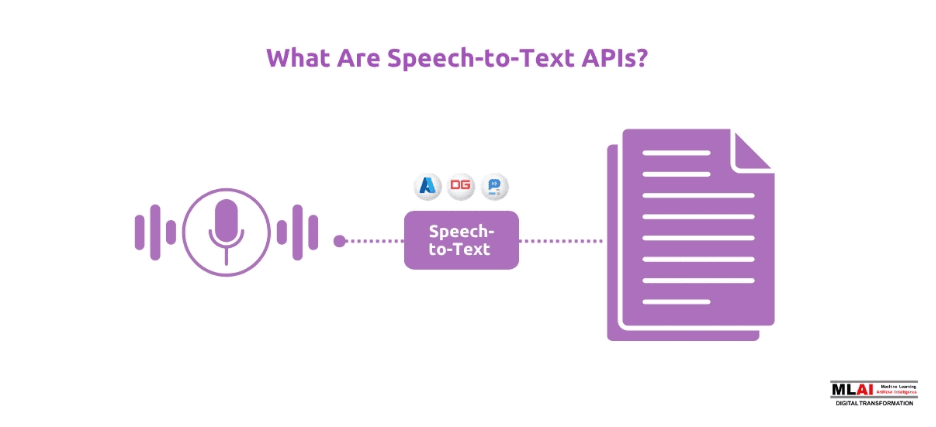
Speech-to-text APIs are software interfaces that convert spoken audio into written text using artificial intelligence and machine learning. Developers integrate speech-to-text APIs into applications to enable voice commands, automated transcription, and real-time speech recognition for services such as voice assistants, call analytics, and meeting transcription tools.
These APIs rely on advanced AI speech recognition API models trained on large speech datasets containing thousands of hours of human speech. Once integrated into an application, the API processes audio input and returns accurate text output.
Developers use speech recognition APIs across many applications such as:
• Voice assistants
• Meeting transcription tools
• Customer service analytics
• Video captioning platforms
• Accessibility solutions
Although the terms are sometimes used interchangeably, there are several related concepts involved in speech processing.
1.1 Speech Recognition
Speech recognition refers to the process of identifying spoken words from audio signals. AI models analyze sound waves, detect speech patterns, and translate them into text that computers can understand.
Modern speech recognition APIs rely on deep learning models trained on large speech datasets that include multiple languages, accents, and speaking styles. Because of this training, these systems can accurately recognize speech even in real-world environments.
Speech recognition technology is widely used in voice assistants, voice search systems, and AI-powered customer service tools.
1.2 Voice Transcription
Voice transcription converts recorded speech into written text. This process usually works with pre-recorded audio such as interviews, podcasts, meeting recordings, or videos.
Organizations often use speech-to-text APIs to automatically transcribe large amounts of audio instead of relying on manual transcription. This helps save time and improves efficiency when processing voice data.
Voice transcription is commonly used in journalism, research, legal documentation, and media production.
1.3 Real-Time Transcription
Real-time transcription converts live speech into text instantly while someone is speaking. A real-time speech-to-text API continuously processes streaming audio and produces text output with minimal delay.
This capability is essential for applications that require immediate responses or live captions. For example, voice assistants, live broadcasting platforms, and virtual meetings depend on real-time transcription technology.
As a result, real-time speech recognition is becoming an essential feature in modern speech-to-text APIs.
1.4 Basic Workflow of Speech-to-Text Systems
Most speech-to-text APIs follow a simple workflow:
Audio Input → Speech Recognition Model → Text Output
Typical workflow steps:
Audio is captured from a microphone, phone call, or audio file.
The speech recognition model analyzes the audio signal.
The system converts speech into text and returns the transcript.
Although the process looks simple, it relies on complex machine learning models working behind the scenes.
2. How Speech-to-Text APIs Work
Modern speech-to-text APIs combine multiple technologies including signal processing, machine learning, and language modeling to convert speech into text accurately.
2.1 Audio Processing and Feature Extraction
The first step in speech recognition is converting sound waves into digital signals. When a person speaks, their voice creates sound waves that microphones capture.
The system then converts these signals into acoustic features that machine learning models can analyze. Spectrograms are often used to represent frequency patterns in speech.
These features allow AI systems to recognize phonemes and words from the audio signal.
2.2 Automatic Speech Recognition Models
The core of speech recognition APIs is Automatic Speech Recognition (ASR) technology.
Modern AI speech recognition API systems use deep learning models trained on large speech datasets. These models learn speech patterns, accents, and pronunciation variations.
Common model architectures include:
• Transformer-based models
• Conformer architectures
• Hybrid ASR systems
Because of these models, modern speech-to-text APIs can achieve high accuracy across different languages and speaking styles.
2.3 Language Modelling
Language models help speech-to-text APIs understand context in speech.
Instead of recognizing individual words independently, language models analyze sentence structure and predict the most likely sequence of words.
This significantly improves speech-to-text API accuracy, especially when multiple words sound similar.
2.4 Post Processing
After the system generates raw transcripts, additional processing improves readability.
Common post-processing features include:
• Automatic punctuation restoration
• Speaker diarization
• Timestamp alignment
• Transcript formatting
These improvements make transcripts easier to read and analyze.
3. Key Features to Look for in Speech-to-Text APIs
When selecting between different speech-to-text APIs, developers should evaluate several critical features.
3.1 Accuracy
Accuracy is the most important metric for any AI speech recognition API. It determines how correctly spoken words are converted into written text.
Accuracy is usually measured using Word Error Rate (WER), which calculates the percentage of incorrectly recognized words compared to the original speech. A lower WER indicates better speech-to-text API accuracy.
Several factors influence transcription accuracy, including the quality of training data and the diversity of speech samples used during model training.
Factors influencing speech-to-text API accuracy include:
• Training dataset size
• Accent and dialect support
• Noise handling capability
• Domain-specific vocabulary support
The best speech-to-text APIs are trained on diverse datasets that include multiple accents, languages, and recording conditions. As a result, these systems can maintain high accuracy even in challenging environments.
3.2 Real-Time Streaming
Many applications require live transcription capabilities instead of processing recorded audio files.
A real-time speech-to-text API processes streaming audio continuously and converts spoken words into text with minimal delay. This allows applications to respond instantly to voice commands or conversations.
Real-time processing is especially important for interactive systems where users expect immediate responses.
This feature is essential for:
• Voice assistants
• Live captions
• Customer support automation
• Interactive AI applications
Low latency ensures smooth real-time interactions. In addition, high-quality speech-to-text APIs are designed to handle continuous audio streams without losing transcription accuracy.
3.3 Multilingual Support
Modern speech recognition APIs support multiple languages and dialects. This capability allows applications to serve users from different regions and linguistic backgrounds.
Multilingual speech recognition is particularly important for global platforms, international businesses, and applications with diverse user bases.
Advanced systems may include:
• Automatic language detection
• Code-switching support
• Regional dialect recognition
For example, code-switching detection allows the system to recognize when speakers switch between languages within a single conversation. As a result, speech-to-text APIs have become more flexible and useful for global communication platforms.
3.4 Speaker Identification
Speaker identification, also called speaker diarization, allows speech-to-text APIs to detect and separate different speakers in a conversation.
Instead of generating a single block of text, the system organizes the transcript based on who is speaking. This makes conversation easier to read and analyze.
This feature is useful for:
• Meeting transcription tools
• Interview recordings
• Call center analytics
For instance, during a meeting transcript, the system can label statements by speaker, which helps teams review discussions more efficiently. Therefore, speaker identification improves the usability of transcripts generated by speech recognition APIs.
3.5 Custom Vocabulary and Domain Adaptation
Some industries use specialized terminology that general speech recognition models may not recognize correctly.
Custom vocabulary allows developers to train speech-to-text APIs with domain-specific words, phrases, or product names. This improves transcription quality in technical or specialized fields.
Examples include:
• Medical terminology
• Legal documentation language
• Technical product terms
For example, healthcare applications may include medical terms such as drug names or clinical terminology. By adapting the recognition model to specific industries, organizations can significantly improve speech-to-text API accuracy for specialized use cases
4. Top Speech-to-Text APIs in 2026
Several companies provide powerful speech-to-text APIs designed for different applications. These APIs use advanced AI models to convert spoken language into text with high accuracy and speed.
However, each provider offers different strengths in terms of accuracy, language support, pricing, and real-time capabilities. Therefore, developers should evaluate different speech recognition APIs based on their specific use cases and integration requirements.
4.1 Google Cloud Speech-to-Text
Google provides one of the most advanced speech recognition APIs available today. It is widely used by enterprises and developers building voice-enabled applications.
Google’s speech-to-text APIs are powered by large machine learning models trained on extensive speech datasets. As a result, the platform delivers high accuracy and reliable performance.
Key features include:
• Strong multilingual support
• High speech-to-text API accuracy
• Real-time streaming capabilities
• Enterprise-grade infrastructure
Because of its scalability and integration with Google Cloud services, this API is often used in large-scale AI applications.
4.2 OpenAI Whisper API
The Whisper API is known for its strong performance in noisy audio environments. It uses deep learning models trained on diverse audio datasets, which helps it handle accents, background noise, and different speaking styles.
Many developers prefer Whisper for transcription tasks because it provides reliable results even when the audio quality is not perfect.
Key advantages include:
• High transcription accuracy
• Multiple language support
• Advanced deep learning architecture
Therefore, it is widely considered one of the best speech-to-text APIs for transcription and research applications.
4.3 Deepgram Speech API
Deepgram focuses primarily on real-time voice processing and conversational AI applications. It is designed to deliver fast transcription results with very low latency.
Because of its streaming capabilities, Deepgram is commonly used in voice assistants, customer service automation, and real-time analytics systems.
Key features include:
• Low latency transcription
• High-performance real-time speech-to-text API
• Voice AI platform integration
These capabilities make Deepgram a strong choice for applications that require instant speech recognition.
4.4 Microsoft Azure Speech Services
Microsoft Azure provides enterprise-ready speech recognition APIs integrated with the Azure AI ecosystem. These services allow developers to build voice-enabled applications using Microsoft’s cloud infrastructure.
Azure Speech Services support multiple languages, real-time transcription, and integration with other Azure AI tools. As a result, many organizations choose Azure when building scalable AI solutions within the Microsoft ecosystem.
4.5 Amazon Transcribe
Amazon Transcribe provides scalable speech-to-text APIs designed for AWS-based applications. It allows developers to convert speech into text for analytics, automation, and content processing.
The service supports both real-time streaming transcription and batch transcription for recorded audio files. Therefore, it is widely used in media processing, customer support analytics, and voice-based applications built on AWS.
5.Comparison of Best Speech-to-Text APIs
API Provider | Accuracy | Real-Time Support | Languages | Best Use Case |
Google Cloud Speech-to-Text | Very High | Yes | 120+ | Enterprise AI |
OpenAI Whisper API | Very High | Limited | 50+ | High accuracy transcription |
Deepgram | High | Yes | 30+ | Voice AI platforms |
Microsoft Azure Speech | High | Yes | 100+ | Enterprise applications |
Amazon Transcribe | High | Yes | 40+ | AWS environments |
6. Real World Use Cases of Speech-to-Text APIs
Many industries use speech-to-text APIs to automate workflows and extract valuable insights from voice data. These APIs allow organizations to convert spoken conversations into searchable and analyzable text.
As a result, businesses can improve productivity, enhance user experience, and gain better insights from voice interactions. Below are some common real-world applications of speech recognition APIs.
6.1 Call Center Analytics
Customer support platforms use speech recognition APIs to transcribe customer service calls automatically. Once the calls are converted into text, companies can analyze conversations for sentiment, keywords, and customer feedback.
For example, companies like Airbnb and Uber analyze customer support calls to identify common issues and improve service quality. Similarly, many contact center platforms use speech-to-text APIs to monitor agent performance and detect customer dissatisfaction in real time.
6.2 Meeting Transcription Tools
AI meeting assistants rely on speech-to-text APIs to generate automated meeting transcripts and notes. This allows teams to focus on discussions instead of manually writing notes.
For instance, tools such as Otter.ai, Zoom AI Companion, and Microsoft Teams transcription automatically convert meeting conversations into text using speech recognition technology. These transcripts can then be searched, shared, and summarized.
6.3 Voice Assistants
Smart assistants depend on real-time speech-to-text APIs to interpret user commands and respond instantly. These systems convert spoken instructions into text before processing them through AI models.
Popular examples include Amazon Alexa, Apple Siri, and Google Assistant. When users give voice commands like "set a reminder" or "play music," these assistants use speech recognition APIs to understand the request.
6.4 Healthcare Documentation
Doctors and healthcare professionals often use voice to text APIs to dictate medical reports, patient notes, and clinical documentation.
For example, healthcare platforms like Nuance Dragon Medical use speech recognition technology to convert doctors’ spoken notes into structured medical records. This reduces administrative workload and allows healthcare professionals to spend more time with patients.
6.5 Accessibility and Subtitles
Video platforms use speech-to-text APIs to generate automatic captions and subtitles. This improves accessibility for people who are deaf or hard of hearing.
For example, YouTube automatic captions and Netflix subtitle generation systems rely on speech recognition technology to convert spoken dialogue into text. These captions also help users understand content in noisy environments or when watching videos without sound.
7. Challenges in Speech Recognition
Despite significant progress in artificial intelligence, speech recognition APIs still face several technical challenges. While modern speech-to-text APIs are highly accurate in controlled environments, real-world audio conditions can sometimes affect transcription quality.
Various factors such as background noise, speaker variations, and specialized terminology can make speech recognition more difficult. However, ongoing improvements in AI models and training datasets are helping to reduce these limitations.
Common challenges include:
7.1 Background Noise
Background noise is one of the most common challenges in speech recognition systems. Sounds such as traffic, conversations, or environmental noise can interfere with the audio signal and reduce speech-to-text API accuracy.
For example, recordings made in crowded environments or public spaces may contain multiple background sounds. As a result, speech recognition APIs must use noise reduction and filtering techniques to isolate the speaker’s voice.
7.2 Multiple Speakers
Another challenge occurs when multiple people speak during the same conversation. Overlapping speech can make it difficult for speech-to-text APIs to correctly identify and separate individual speakers.
Although modern systems use speaker diarization to label speakers, recognizing overlapping dialogue in real-time conversations remains a complex task.
7.3 Accent Variations
People speak the same language with different accents, pronunciations, and speaking styles. These variations can sometimes affect the performance of speech recognition APIs.
For example, English spoken in the United States, India, or the United Kingdom may sound different. Therefore, speech models must be trained on diverse datasets to ensure high speech-to-text API accuracy across global users.
7.4 Domain-Specific Terminology
Certain industries use specialized terminology that general speech recognition models may not recognize accurately. Technical terms, product names, or medical vocabulary may not appear frequently in general training datasets.
To address this challenge, many speech-to-text APIs allow developers to add custom vocabulary or domain adaptation. This helps improve recognition accuracy for industry-specific applications.
8. Future of Speech-to-Text APIs
The future of speech-to-text APIs is closely linked with advancements in artificial intelligence.
Emerging trends include:
8.1 Real-Time AI Voice Assistants
Real-time AI assistants are becoming more advanced and conversational. Modern assistants rely heavily on real-time speech-to-text APIs to understand user commands instantly and respond naturally.
For example, platforms such as Amazon Alexa, Apple Siri, and Google Assistant already use speech recognition technology to interpret voice commands. In the future, these systems will become more context-aware and capable of handling complex conversations.
8.2 Multimodal AI Systems
Multimodal AI combines different types of data such as speech, text, images, and video. In these systems, speech-to-text APIs play an important role by converting voice input into text that other AI models can analyze.
For instance, AI tools like ChatGPT voice mode and Google Gemini combine speech recognition with language models and visual understanding. This allows users to interact with AI using voice, images, and text simultaneously.
8.3 Edge Speech Recognition
Edge speech recognition processes audio directly on devices instead of sending it to cloud servers. This approach improves privacy, reduces latency, and allows speech recognition to work even without a stable internet connection.
For example, Apple’s on-device speech recognition in iPhones and Google’s offline voice typing on Android use edge AI to process speech locally. As hardware improves, more speech-to-text APIs will support edge-based processing.
8.4 Integration with Large Language Models
Another major trend is the integration of speech-to-text APIs with large language models (LLMs). After speech is converted into text, LLMs can analyze the content, summarize conversations, or generate intelligent responses.
For example, AI meeting tools like Otter.ai AI summaries and Microsoft Copilot meeting recap combine speech recognition with language models to automatically generate meeting summaries and action items.
Conclusion
Speech technology is rapidly transforming how people interact with digital systems. Speech-to-text APIs play a crucial role in enabling voice-driven applications such as virtual assistants, meeting transcription tools, customer support analytics, and accessibility solutions. As discussed throughout this guide, modern speech-to-text APIs offer high accuracy, multilingual capabilities, and real-time processing powered by advanced AI models. However, choosing the right solution requires evaluating factors such as performance, scalability, and use case requirements. As artificial intelligence continues to evolve, speech recognition APIs will become even more powerful, enabling smarter automation and more natural human-computer interactions across industries.
For businesses exploring AI adoption, solutions and insights from MLAI Digital can help in selecting and implementing the most suitable speech-to-text technologies for real-world applications.
Introduction
Voice technology is rapidly changing how people interact with digital systems. From voice assistants and automated meeting notes to customer support automation, voice-driven interfaces are becoming a core part of modern applications. At the center of these systems are speech-to-text APIs, which allow machines to convert spoken language into written text.
In recent years, the demand for speech recognition APIs has increased significantly. Businesses now rely on voice technologies to automate processes, analyze customer conversations, and improve accessibility for users. These systems are used to transcribe meetings, generate subtitles for videos, process customer calls, and power conversational AI platforms.
A voice to text API allows developers to integrate speech recognition capabilities into websites, mobile apps, and enterprise software. With a simple API integration, applications can process audio recordings or live speech and convert them into text automatically.
However, choosing the right speech-to-text APIs is important. Different providers offer different levels of speech-to-text API accuracy, language support, pricing models, and real-time processing capabilities.
This guide explores the best speech-to-text APIs in 2026, explaining how they work, their features, pricing models, and real-world applications.
1. What Are Speech-to-Text APIs?
Speech-to-text APIs are software interfaces that convert spoken audio into written text using artificial intelligence and machine learning. Developers integrate speech-to-text APIs into applications to enable voice commands, automated transcription, and real-time speech recognition for services such as voice assistants, call analytics, and meeting transcription tools.
These APIs rely on advanced AI speech recognition API models trained on large speech datasets containing thousands of hours of human speech. Once integrated into an application, the API processes audio input and returns accurate text output.
Developers use speech recognition APIs across many applications such as:
• Voice assistants
• Meeting transcription tools
• Customer service analytics
• Video captioning platforms
• Accessibility solutions
Although the terms are sometimes used interchangeably, there are several related concepts involved in speech processing.
1.1 Speech Recognition
Speech recognition refers to the process of identifying spoken words from audio signals. AI models analyze sound waves, detect speech patterns, and translate them into text that computers can understand.
Modern speech recognition APIs rely on deep learning models trained on large speech datasets that include multiple languages, accents, and speaking styles. Because of this training, these systems can accurately recognize speech even in real-world environments.
Speech recognition technology is widely used in voice assistants, voice search systems, and AI-powered customer service tools.
1.2 Voice Transcription
Voice transcription converts recorded speech into written text. This process usually works with pre-recorded audio such as interviews, podcasts, meeting recordings, or videos.
Organizations often use speech-to-text APIs to automatically transcribe large amounts of audio instead of relying on manual transcription. This helps save time and improves efficiency when processing voice data.
Voice transcription is commonly used in journalism, research, legal documentation, and media production.
1.3 Real-Time Transcription
Real-time transcription converts live speech into text instantly while someone is speaking. A real-time speech-to-text API continuously processes streaming audio and produces text output with minimal delay.
This capability is essential for applications that require immediate responses or live captions. For example, voice assistants, live broadcasting platforms, and virtual meetings depend on real-time transcription technology.
As a result, real-time speech recognition is becoming an essential feature in modern speech-to-text APIs.
1.4 Basic Workflow of Speech-to-Text Systems
Most speech-to-text APIs follow a simple workflow:
Audio Input → Speech Recognition Model → Text Output
Typical workflow steps:
Audio is captured from a microphone, phone call, or audio file.
The speech recognition model analyzes the audio signal.
The system converts speech into text and returns the transcript.
Although the process looks simple, it relies on complex machine learning models working behind the scenes.
2. How Speech-to-Text APIs Work
Modern speech-to-text APIs combine multiple technologies including signal processing, machine learning, and language modeling to convert speech into text accurately.
2.1 Audio Processing and Feature Extraction
The first step in speech recognition is converting sound waves into digital signals. When a person speaks, their voice creates sound waves that microphones capture.
The system then converts these signals into acoustic features that machine learning models can analyze. Spectrograms are often used to represent frequency patterns in speech.
These features allow AI systems to recognize phonemes and words from the audio signal.
2.2 Automatic Speech Recognition Models
The core of speech recognition APIs is Automatic Speech Recognition (ASR) technology.
Modern AI speech recognition API systems use deep learning models trained on large speech datasets. These models learn speech patterns, accents, and pronunciation variations.
Common model architectures include:
• Transformer-based models
• Conformer architectures
• Hybrid ASR systems
Because of these models, modern speech-to-text APIs can achieve high accuracy across different languages and speaking styles.
2.3 Language Modelling
Language models help speech-to-text APIs understand context in speech.
Instead of recognizing individual words independently, language models analyze sentence structure and predict the most likely sequence of words.
This significantly improves speech-to-text API accuracy, especially when multiple words sound similar.
2.4 Post Processing
After the system generates raw transcripts, additional processing improves readability.
Common post-processing features include:
• Automatic punctuation restoration
• Speaker diarization
• Timestamp alignment
• Transcript formatting
These improvements make transcripts easier to read and analyze.
3. Key Features to Look for in Speech-to-Text APIs
When selecting between different speech-to-text APIs, developers should evaluate several critical features.
3.1 Accuracy
Accuracy is the most important metric for any AI speech recognition API. It determines how correctly spoken words are converted into written text.
Accuracy is usually measured using Word Error Rate (WER), which calculates the percentage of incorrectly recognized words compared to the original speech. A lower WER indicates better speech-to-text API accuracy.
Several factors influence transcription accuracy, including the quality of training data and the diversity of speech samples used during model training.
Factors influencing speech-to-text API accuracy include:
• Training dataset size
• Accent and dialect support
• Noise handling capability
• Domain-specific vocabulary support
The best speech-to-text APIs are trained on diverse datasets that include multiple accents, languages, and recording conditions. As a result, these systems can maintain high accuracy even in challenging environments.
3.2 Real-Time Streaming
Many applications require live transcription capabilities instead of processing recorded audio files.
A real-time speech-to-text API processes streaming audio continuously and converts spoken words into text with minimal delay. This allows applications to respond instantly to voice commands or conversations.
Real-time processing is especially important for interactive systems where users expect immediate responses.
This feature is essential for:
• Voice assistants
• Live captions
• Customer support automation
• Interactive AI applications
Low latency ensures smooth real-time interactions. In addition, high-quality speech-to-text APIs are designed to handle continuous audio streams without losing transcription accuracy.
3.3 Multilingual Support
Modern speech recognition APIs support multiple languages and dialects. This capability allows applications to serve users from different regions and linguistic backgrounds.
Multilingual speech recognition is particularly important for global platforms, international businesses, and applications with diverse user bases.
Advanced systems may include:
• Automatic language detection
• Code-switching support
• Regional dialect recognition
For example, code-switching detection allows the system to recognize when speakers switch between languages within a single conversation. As a result, speech-to-text APIs have become more flexible and useful for global communication platforms.
3.4 Speaker Identification
Speaker identification, also called speaker diarization, allows speech-to-text APIs to detect and separate different speakers in a conversation.
Instead of generating a single block of text, the system organizes the transcript based on who is speaking. This makes conversation easier to read and analyze.
This feature is useful for:
• Meeting transcription tools
• Interview recordings
• Call center analytics
For instance, during a meeting transcript, the system can label statements by speaker, which helps teams review discussions more efficiently. Therefore, speaker identification improves the usability of transcripts generated by speech recognition APIs.
3.5 Custom Vocabulary and Domain Adaptation
Some industries use specialized terminology that general speech recognition models may not recognize correctly.
Custom vocabulary allows developers to train speech-to-text APIs with domain-specific words, phrases, or product names. This improves transcription quality in technical or specialized fields.
Examples include:
• Medical terminology
• Legal documentation language
• Technical product terms
For example, healthcare applications may include medical terms such as drug names or clinical terminology. By adapting the recognition model to specific industries, organizations can significantly improve speech-to-text API accuracy for specialized use cases
4. Top Speech-to-Text APIs in 2026
Several companies provide powerful speech-to-text APIs designed for different applications. These APIs use advanced AI models to convert spoken language into text with high accuracy and speed.
However, each provider offers different strengths in terms of accuracy, language support, pricing, and real-time capabilities. Therefore, developers should evaluate different speech recognition APIs based on their specific use cases and integration requirements.
4.1 Google Cloud Speech-to-Text
Google provides one of the most advanced speech recognition APIs available today. It is widely used by enterprises and developers building voice-enabled applications.
Google’s speech-to-text APIs are powered by large machine learning models trained on extensive speech datasets. As a result, the platform delivers high accuracy and reliable performance.
Key features include:
• Strong multilingual support
• High speech-to-text API accuracy
• Real-time streaming capabilities
• Enterprise-grade infrastructure
Because of its scalability and integration with Google Cloud services, this API is often used in large-scale AI applications.
4.2 OpenAI Whisper API
The Whisper API is known for its strong performance in noisy audio environments. It uses deep learning models trained on diverse audio datasets, which helps it handle accents, background noise, and different speaking styles.
Many developers prefer Whisper for transcription tasks because it provides reliable results even when the audio quality is not perfect.
Key advantages include:
• High transcription accuracy
• Multiple language support
• Advanced deep learning architecture
Therefore, it is widely considered one of the best speech-to-text APIs for transcription and research applications.
4.3 Deepgram Speech API
Deepgram focuses primarily on real-time voice processing and conversational AI applications. It is designed to deliver fast transcription results with very low latency.
Because of its streaming capabilities, Deepgram is commonly used in voice assistants, customer service automation, and real-time analytics systems.
Key features include:
• Low latency transcription
• High-performance real-time speech-to-text API
• Voice AI platform integration
These capabilities make Deepgram a strong choice for applications that require instant speech recognition.
4.4 Microsoft Azure Speech Services
Microsoft Azure provides enterprise-ready speech recognition APIs integrated with the Azure AI ecosystem. These services allow developers to build voice-enabled applications using Microsoft’s cloud infrastructure.
Azure Speech Services support multiple languages, real-time transcription, and integration with other Azure AI tools. As a result, many organizations choose Azure when building scalable AI solutions within the Microsoft ecosystem.
4.5 Amazon Transcribe
Amazon Transcribe provides scalable speech-to-text APIs designed for AWS-based applications. It allows developers to convert speech into text for analytics, automation, and content processing.
The service supports both real-time streaming transcription and batch transcription for recorded audio files. Therefore, it is widely used in media processing, customer support analytics, and voice-based applications built on AWS.
5.Comparison of Best Speech-to-Text APIs
API Provider | Accuracy | Real-Time Support | Languages | Best Use Case |
Google Cloud Speech-to-Text | Very High | Yes | 120+ | Enterprise AI |
OpenAI Whisper API | Very High | Limited | 50+ | High accuracy transcription |
Deepgram | High | Yes | 30+ | Voice AI platforms |
Microsoft Azure Speech | High | Yes | 100+ | Enterprise applications |
Amazon Transcribe | High | Yes | 40+ | AWS environments |
6. Real World Use Cases of Speech-to-Text APIs
Many industries use speech-to-text APIs to automate workflows and extract valuable insights from voice data. These APIs allow organizations to convert spoken conversations into searchable and analyzable text.
As a result, businesses can improve productivity, enhance user experience, and gain better insights from voice interactions. Below are some common real-world applications of speech recognition APIs.
6.1 Call Center Analytics
Customer support platforms use speech recognition APIs to transcribe customer service calls automatically. Once the calls are converted into text, companies can analyze conversations for sentiment, keywords, and customer feedback.
For example, companies like Airbnb and Uber analyze customer support calls to identify common issues and improve service quality. Similarly, many contact center platforms use speech-to-text APIs to monitor agent performance and detect customer dissatisfaction in real time.
6.2 Meeting Transcription Tools
AI meeting assistants rely on speech-to-text APIs to generate automated meeting transcripts and notes. This allows teams to focus on discussions instead of manually writing notes.
For instance, tools such as Otter.ai, Zoom AI Companion, and Microsoft Teams transcription automatically convert meeting conversations into text using speech recognition technology. These transcripts can then be searched, shared, and summarized.
6.3 Voice Assistants
Smart assistants depend on real-time speech-to-text APIs to interpret user commands and respond instantly. These systems convert spoken instructions into text before processing them through AI models.
Popular examples include Amazon Alexa, Apple Siri, and Google Assistant. When users give voice commands like "set a reminder" or "play music," these assistants use speech recognition APIs to understand the request.
6.4 Healthcare Documentation
Doctors and healthcare professionals often use voice to text APIs to dictate medical reports, patient notes, and clinical documentation.
For example, healthcare platforms like Nuance Dragon Medical use speech recognition technology to convert doctors’ spoken notes into structured medical records. This reduces administrative workload and allows healthcare professionals to spend more time with patients.
6.5 Accessibility and Subtitles
Video platforms use speech-to-text APIs to generate automatic captions and subtitles. This improves accessibility for people who are deaf or hard of hearing.
For example, YouTube automatic captions and Netflix subtitle generation systems rely on speech recognition technology to convert spoken dialogue into text. These captions also help users understand content in noisy environments or when watching videos without sound.
7. Challenges in Speech Recognition
Despite significant progress in artificial intelligence, speech recognition APIs still face several technical challenges. While modern speech-to-text APIs are highly accurate in controlled environments, real-world audio conditions can sometimes affect transcription quality.
Various factors such as background noise, speaker variations, and specialized terminology can make speech recognition more difficult. However, ongoing improvements in AI models and training datasets are helping to reduce these limitations.
Common challenges include:
7.1 Background Noise
Background noise is one of the most common challenges in speech recognition systems. Sounds such as traffic, conversations, or environmental noise can interfere with the audio signal and reduce speech-to-text API accuracy.
For example, recordings made in crowded environments or public spaces may contain multiple background sounds. As a result, speech recognition APIs must use noise reduction and filtering techniques to isolate the speaker’s voice.
7.2 Multiple Speakers
Another challenge occurs when multiple people speak during the same conversation. Overlapping speech can make it difficult for speech-to-text APIs to correctly identify and separate individual speakers.
Although modern systems use speaker diarization to label speakers, recognizing overlapping dialogue in real-time conversations remains a complex task.
7.3 Accent Variations
People speak the same language with different accents, pronunciations, and speaking styles. These variations can sometimes affect the performance of speech recognition APIs.
For example, English spoken in the United States, India, or the United Kingdom may sound different. Therefore, speech models must be trained on diverse datasets to ensure high speech-to-text API accuracy across global users.
7.4 Domain-Specific Terminology
Certain industries use specialized terminology that general speech recognition models may not recognize accurately. Technical terms, product names, or medical vocabulary may not appear frequently in general training datasets.
To address this challenge, many speech-to-text APIs allow developers to add custom vocabulary or domain adaptation. This helps improve recognition accuracy for industry-specific applications.
8. Future of Speech-to-Text APIs
The future of speech-to-text APIs is closely linked with advancements in artificial intelligence.
Emerging trends include:
8.1 Real-Time AI Voice Assistants
Real-time AI assistants are becoming more advanced and conversational. Modern assistants rely heavily on real-time speech-to-text APIs to understand user commands instantly and respond naturally.
For example, platforms such as Amazon Alexa, Apple Siri, and Google Assistant already use speech recognition technology to interpret voice commands. In the future, these systems will become more context-aware and capable of handling complex conversations.
8.2 Multimodal AI Systems
Multimodal AI combines different types of data such as speech, text, images, and video. In these systems, speech-to-text APIs play an important role by converting voice input into text that other AI models can analyze.
For instance, AI tools like ChatGPT voice mode and Google Gemini combine speech recognition with language models and visual understanding. This allows users to interact with AI using voice, images, and text simultaneously.
8.3 Edge Speech Recognition
Edge speech recognition processes audio directly on devices instead of sending it to cloud servers. This approach improves privacy, reduces latency, and allows speech recognition to work even without a stable internet connection.
For example, Apple’s on-device speech recognition in iPhones and Google’s offline voice typing on Android use edge AI to process speech locally. As hardware improves, more speech-to-text APIs will support edge-based processing.
8.4 Integration with Large Language Models
Another major trend is the integration of speech-to-text APIs with large language models (LLMs). After speech is converted into text, LLMs can analyze the content, summarize conversations, or generate intelligent responses.
For example, AI meeting tools like Otter.ai AI summaries and Microsoft Copilot meeting recap combine speech recognition with language models to automatically generate meeting summaries and action items.
Conclusion
Speech technology is rapidly transforming how people interact with digital systems. Speech-to-text APIs play a crucial role in enabling voice-driven applications such as virtual assistants, meeting transcription tools, customer support analytics, and accessibility solutions. As discussed throughout this guide, modern speech-to-text APIs offer high accuracy, multilingual capabilities, and real-time processing powered by advanced AI models. However, choosing the right solution requires evaluating factors such as performance, scalability, and use case requirements. As artificial intelligence continues to evolve, speech recognition APIs will become even more powerful, enabling smarter automation and more natural human-computer interactions across industries.
For businesses exploring AI adoption, solutions and insights from MLAI Digital can help in selecting and implementing the most suitable speech-to-text technologies for real-world applications.
Related Blogs
Be the first to read our articles.

