


How AI Agents Are Transforming Cybersecurity Teams in 2026
Prerna Sahni
AI Agents
Cybersecurity teams are at a breaking point. Alerts are piling up faster than analysts can review them; attackers are getting smarter, and finding skilled security talent feels like searching for a needle in a haystack. Something had to change, and in 2026, that change has a name: AI Agents in Cybersecurity.
These are not glorified automation scripts. They are intelligent systems that reason through threats, connect dots across multiple tools, and take action without waiting for a human to give the green light. If your organisation handles sensitive data, this shift is already relevant to you, whether you are ready for it or not.
1. What Are AI Agents in Cybersecurity?
Most people hear "AI agent" and picture a chatbot. The reality is far more capable.
An AI security agent does not just follow a rulebook. It reads context, weighs signals, makes decisions, and executes multi-step tasks on its own. Think of it as a digital analyst that works around the clock, never gets tired, and can process thousands of events at once.
When suspicious login activity hits the network, an AI Agents in Cybersecurity system will scan authentication logs, check behavioral baselines, pull endpoint data, assess risk, and either resolve the issue or escalate it to a human analyst. All of this happens in seconds, not hours. The analyst only gets involved when the situation genuinely needs them.
That alone changes the entire dynamic of how a security team operates.
2. Why Teams Are Adopting AI Agents So Fast
The pressure on security teams has been building for years. Too many alerts, too few people, and budgets that do not stretch as far as the threat landscape demands. AI agents are a practical answer to a very real operational problem.
2.1 Cutting Through Alert Fatigue
SOC analysts spend a huge chunk of their day reviewing alerts that turn out to be nothing. AI-powered SOC systems filter out the noise automatically, correlate related events, and hand analysts for a much smaller, much more relevant set of incidents to review. Teams report that the quality of what lands in their queue goes up dramatically.
2.2 Faster Investigations
A traditional threat investigation means an analyst manually pulling data from multiple systems and piecing together a timeline. An AI security agent does all of that simultaneously and delivers a structured summary before the analyst has even logged in. What used to take 30 to 45 minutes now takes under a minute.
2.3 Scaling Without Hiring
Cybersecurity talent is expensive and hard to find. With cybersecurity automation handling Tier-1 tasks like phishing triage, malware classification, login anomaly checks, and routine compliance monitoring, a lean team can cover far more ground than its headcount would suggest. For MSSPs, financial institutions, and large enterprises, this is a genuine operational advantage.
2.4 Automating Tier-1 Security Tasks
A significant portion of what a Tier-1 analyst does every day is repetitive and process-driven. AI security agents absorb this layer entirely, executing tasks faster and more consistently, without the cognitive fatigue that affects human performance over time. This frees your best people to focus on advanced threat hunting and complex incident responses.
3. The Rise of Autonomous Security Operations
The industry is moving beyond basic automation into something more significant: autonomous cybersecurity.
This does not mean removing humans from the picture. It means flipping the default. Instead of humans doing everything and automation helping occasionally, AI agents run continuously, and humans step in when their judgment is actually needed. The AI-powered SOC monitors environments 24/7, kicks off investigations automatically, and executes approved response workflows without delay.
Organizations using AI-driven workflows are seeing real improvements in how quickly they detect and contain threats. Faster detection means less exposure. Less exposure means less damage.
4. How AI Security Agents Actually Work
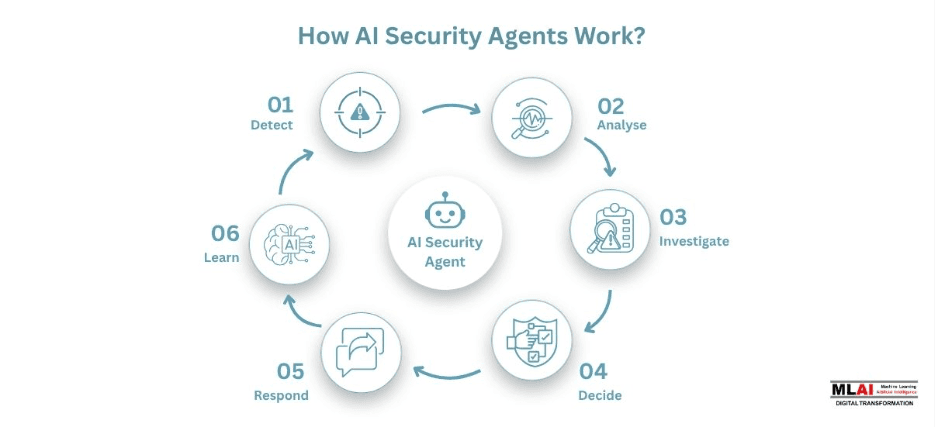
Modern AI security deployments are not a single model for doing everything. They are coordinated systems where specialized agents each handle a specific part of the workflow.
A detection agent watches telemetry streams and flags anomalies.
An investigation agent picks up from there, gathering evidence and building a timeline.
A threat intelligence agent enriches the findings against known attack patterns.
A response agent executes remediation if needed.
A governance agent makes sure every action stays within policy limits.
A reporting agent puts together a readable summary for the human analyst.
Each agent feeds information to the others, creating a shared picture of the threat that is richer and faster than anything a single analyst could build manually. AI Agents in Cybersecurity work like a coordinated team, one that operates without breaks and does not miss a shift.
5. How MERV.ONE Is Building AI Security Agents
MERV.ONE is one of the platforms helping organizations actually deploy this kind of capability at scale. Their Security Agents platform is built for production environments, not lab demos. It focuses on practical deployment with real governance controls, auditability, and the reliability enterprise security teams need.
The platform covers security monitoring, threat investigation, compliance workflows, and intelligent alert triage. As AI-first security becomes less of a differentiator and more of a baseline expectation, platforms like MERV.ONE are becoming part of the standard security stack for serious enterprises.
6. The Human Role Is Changing, Not Disappearing
Every time AI agents come up in a security context, someone raises the question of job displacement. It is worth addressing directly.
Analysts are not being replaced. Their jobs are changing shape. The repetitive, process-heavy work is moving to AI. The strategic, judgment-heavy work is staying with humans and in many cases expanding. Security professionals are becoming AI workflow supervisors, advanced threat hunters, and automation architects. Those are more interesting jobs, not less valuable ones.
AI Agents in Cybersecurity raise the ceiling for what a security team can accomplish. A skilled analyst working alongside autonomous cybersecurity systems can cover grounds that would have required a much larger team just a few years ago.
7. Real Risks Worth Knowing
It would be dishonest to talk about AI security agents without acknowledging the risks that come with them.
7.1 AI Hallucinations
AI models can be wrong. A misconfigured or poorly supervised agent might misclassify a real threat or flag something clean for remediation. Human oversight is not a nice-to-have. It is a requirement for any responsible deployment.
7.2 Agent Security Risks
AI agents can also become targets themselves. Attackers are already looking at ways to exploit agent memory, manipulate integrations, and use prompt injection to hijack agent behavior. If an agent has the permissions to execute remediation workflows, compromising it is a serious risk. Organizations need to apply the same security discipline to their AI agents that they apply to any critical system.
7.3 Governance and Compliance Concerns
When an autonomous agent makes a decision that creates a compliance issue, accountability gets complicated fast. Organizations need clear policies around what agents can and cannot do, when human approval is required, and how every action is logged.
8. What the Future SOC Looks Like
Five years from now, the SOC will look very different. There will not be analysts working through endless queues of low-priority alerts. There will not be threats sitting undetected for days because the signal got buried in noise.
AI threat detection agents will watch everything continuously; investigations will kick off automatically, and by the time a human analyst sees an incident, the groundwork is already done. Human analysts will focus on modeling attacker behavior, handling genuinely novel situations, designing governance frameworks, and leading the response to major incidents.
The organizations that figure out how to combine AI Agents in Cybersecurity with strong human expertise will build defenses that are faster and more resilient than anything a purely human-driven operation could achieve.
9. Final Thoughts
AI Agents in Cybersecurity are not a future consideration anymore. They are an operational reality in 2026. The question is no longer whether to adopt them but how to do it in a way that is responsible, governed, and built around the right balance of automation and human judgment.
The threat landscape is not slowing down. Investing in AI security agents now, and building the internal know-how to manage them well, puts organizations in a far stronger position when the next wave of attacks arrives.
Summary
AI Agents in Cybersecurity are reshaping how security teams operate in 2026. Through cybersecurity automation, AI threat detection, and autonomous cybersecurity workflows, modern AI-powered SOC environments are cutting alert fatigue, speeding up investigations, and helping teams scale without adding headcount. AI security agents handle routine Tier-1 tasks so human analysts can focus on higher-value work. Risks around hallucinations, agent vulnerabilities, and governance need careful management, but the direction is clear. Organizations that combine AI agents with strong human oversight will build faster, smarter defenses and stay ahead of a threat landscape that shows no signs of slowing down.
Cybersecurity teams are at a breaking point. Alerts are piling up faster than analysts can review them; attackers are getting smarter, and finding skilled security talent feels like searching for a needle in a haystack. Something had to change, and in 2026, that change has a name: AI Agents in Cybersecurity.
These are not glorified automation scripts. They are intelligent systems that reason through threats, connect dots across multiple tools, and take action without waiting for a human to give the green light. If your organisation handles sensitive data, this shift is already relevant to you, whether you are ready for it or not.
1. What Are AI Agents in Cybersecurity?
Most people hear "AI agent" and picture a chatbot. The reality is far more capable.
An AI security agent does not just follow a rulebook. It reads context, weighs signals, makes decisions, and executes multi-step tasks on its own. Think of it as a digital analyst that works around the clock, never gets tired, and can process thousands of events at once.
When suspicious login activity hits the network, an AI Agents in Cybersecurity system will scan authentication logs, check behavioral baselines, pull endpoint data, assess risk, and either resolve the issue or escalate it to a human analyst. All of this happens in seconds, not hours. The analyst only gets involved when the situation genuinely needs them.
That alone changes the entire dynamic of how a security team operates.
2. Why Teams Are Adopting AI Agents So Fast
The pressure on security teams has been building for years. Too many alerts, too few people, and budgets that do not stretch as far as the threat landscape demands. AI agents are a practical answer to a very real operational problem.
2.1 Cutting Through Alert Fatigue
SOC analysts spend a huge chunk of their day reviewing alerts that turn out to be nothing. AI-powered SOC systems filter out the noise automatically, correlate related events, and hand analysts for a much smaller, much more relevant set of incidents to review. Teams report that the quality of what lands in their queue goes up dramatically.
2.2 Faster Investigations
A traditional threat investigation means an analyst manually pulling data from multiple systems and piecing together a timeline. An AI security agent does all of that simultaneously and delivers a structured summary before the analyst has even logged in. What used to take 30 to 45 minutes now takes under a minute.
2.3 Scaling Without Hiring
Cybersecurity talent is expensive and hard to find. With cybersecurity automation handling Tier-1 tasks like phishing triage, malware classification, login anomaly checks, and routine compliance monitoring, a lean team can cover far more ground than its headcount would suggest. For MSSPs, financial institutions, and large enterprises, this is a genuine operational advantage.
2.4 Automating Tier-1 Security Tasks
A significant portion of what a Tier-1 analyst does every day is repetitive and process-driven. AI security agents absorb this layer entirely, executing tasks faster and more consistently, without the cognitive fatigue that affects human performance over time. This frees your best people to focus on advanced threat hunting and complex incident responses.
3. The Rise of Autonomous Security Operations
The industry is moving beyond basic automation into something more significant: autonomous cybersecurity.
This does not mean removing humans from the picture. It means flipping the default. Instead of humans doing everything and automation helping occasionally, AI agents run continuously, and humans step in when their judgment is actually needed. The AI-powered SOC monitors environments 24/7, kicks off investigations automatically, and executes approved response workflows without delay.
Organizations using AI-driven workflows are seeing real improvements in how quickly they detect and contain threats. Faster detection means less exposure. Less exposure means less damage.
4. How AI Security Agents Actually Work
Modern AI security deployments are not a single model for doing everything. They are coordinated systems where specialized agents each handle a specific part of the workflow.
A detection agent watches telemetry streams and flags anomalies.
An investigation agent picks up from there, gathering evidence and building a timeline.
A threat intelligence agent enriches the findings against known attack patterns.
A response agent executes remediation if needed.
A governance agent makes sure every action stays within policy limits.
A reporting agent puts together a readable summary for the human analyst.
Each agent feeds information to the others, creating a shared picture of the threat that is richer and faster than anything a single analyst could build manually. AI Agents in Cybersecurity work like a coordinated team, one that operates without breaks and does not miss a shift.
5. How MERV.ONE Is Building AI Security Agents
MERV.ONE is one of the platforms helping organizations actually deploy this kind of capability at scale. Their Security Agents platform is built for production environments, not lab demos. It focuses on practical deployment with real governance controls, auditability, and the reliability enterprise security teams need.
The platform covers security monitoring, threat investigation, compliance workflows, and intelligent alert triage. As AI-first security becomes less of a differentiator and more of a baseline expectation, platforms like MERV.ONE are becoming part of the standard security stack for serious enterprises.
6. The Human Role Is Changing, Not Disappearing
Every time AI agents come up in a security context, someone raises the question of job displacement. It is worth addressing directly.
Analysts are not being replaced. Their jobs are changing shape. The repetitive, process-heavy work is moving to AI. The strategic, judgment-heavy work is staying with humans and in many cases expanding. Security professionals are becoming AI workflow supervisors, advanced threat hunters, and automation architects. Those are more interesting jobs, not less valuable ones.
AI Agents in Cybersecurity raise the ceiling for what a security team can accomplish. A skilled analyst working alongside autonomous cybersecurity systems can cover grounds that would have required a much larger team just a few years ago.
7. Real Risks Worth Knowing
It would be dishonest to talk about AI security agents without acknowledging the risks that come with them.
7.1 AI Hallucinations
AI models can be wrong. A misconfigured or poorly supervised agent might misclassify a real threat or flag something clean for remediation. Human oversight is not a nice-to-have. It is a requirement for any responsible deployment.
7.2 Agent Security Risks
AI agents can also become targets themselves. Attackers are already looking at ways to exploit agent memory, manipulate integrations, and use prompt injection to hijack agent behavior. If an agent has the permissions to execute remediation workflows, compromising it is a serious risk. Organizations need to apply the same security discipline to their AI agents that they apply to any critical system.
7.3 Governance and Compliance Concerns
When an autonomous agent makes a decision that creates a compliance issue, accountability gets complicated fast. Organizations need clear policies around what agents can and cannot do, when human approval is required, and how every action is logged.
8. What the Future SOC Looks Like
Five years from now, the SOC will look very different. There will not be analysts working through endless queues of low-priority alerts. There will not be threats sitting undetected for days because the signal got buried in noise.
AI threat detection agents will watch everything continuously; investigations will kick off automatically, and by the time a human analyst sees an incident, the groundwork is already done. Human analysts will focus on modeling attacker behavior, handling genuinely novel situations, designing governance frameworks, and leading the response to major incidents.
The organizations that figure out how to combine AI Agents in Cybersecurity with strong human expertise will build defenses that are faster and more resilient than anything a purely human-driven operation could achieve.
9. Final Thoughts
AI Agents in Cybersecurity are not a future consideration anymore. They are an operational reality in 2026. The question is no longer whether to adopt them but how to do it in a way that is responsible, governed, and built around the right balance of automation and human judgment.
The threat landscape is not slowing down. Investing in AI security agents now, and building the internal know-how to manage them well, puts organizations in a far stronger position when the next wave of attacks arrives.
Summary
AI Agents in Cybersecurity are reshaping how security teams operate in 2026. Through cybersecurity automation, AI threat detection, and autonomous cybersecurity workflows, modern AI-powered SOC environments are cutting alert fatigue, speeding up investigations, and helping teams scale without adding headcount. AI security agents handle routine Tier-1 tasks so human analysts can focus on higher-value work. Risks around hallucinations, agent vulnerabilities, and governance need careful management, but the direction is clear. Organizations that combine AI agents with strong human oversight will build faster, smarter defenses and stay ahead of a threat landscape that shows no signs of slowing down.
Related Blogs
Be the first to read our articles.

