


What is Generative AI? - MLAI Digital
Prerna Sahni
Generative AI
Generative AI is changing how we create content online. Today, tools can write articles, generate images, create videos, and even help with coding in just a few seconds. Because of this, many people are asking a simple question: what is generative AI and how does it actually work?
Generative AI is a type of artificial intelligence that creates new content such as text, images, videos, or code. Instead of just analyzing data, it produces something new based on what it has learned.
For example, tools like ChatGPT can write blogs or answer questions, while platforms like Midjourney and DALL·E can create realistic images from simple text prompts. These tools are not copying content. Instead, they generate original outputs using patterns learned from large datasets.
In this guide, you will learn what is generative AI in simple terms, how generative AI works, and see real-life generative AI examples that make everything easy to understand.
1.What is Generative AI in Simple Terms?
Let’s break down what is generative AI in the simplest way possible.
In simple terms, generative AI is a technology that can create new content instead of just analyzing existing data. This is what makes it different from traditional AI systems.
Earlier, most AI systems were designed to recognize patterns or make predictions. For example, they could recommend movies or detect spam emails. However, they could not create something entirely new.
On the other hand, generative AI can:
Write articles
Generate images
Create music
Produce videos
Even write code
Because of this, the generative AI meaning is closely linked to creativity and content generation.
Another way to understand the generative AI definition is this:
Generative AI learns from data and then uses that knowledge to create new, original outputs.
This is why tools powered by generative AI feel more “human-like” compared to older AI systems.
2.How Does Generative AI Work?
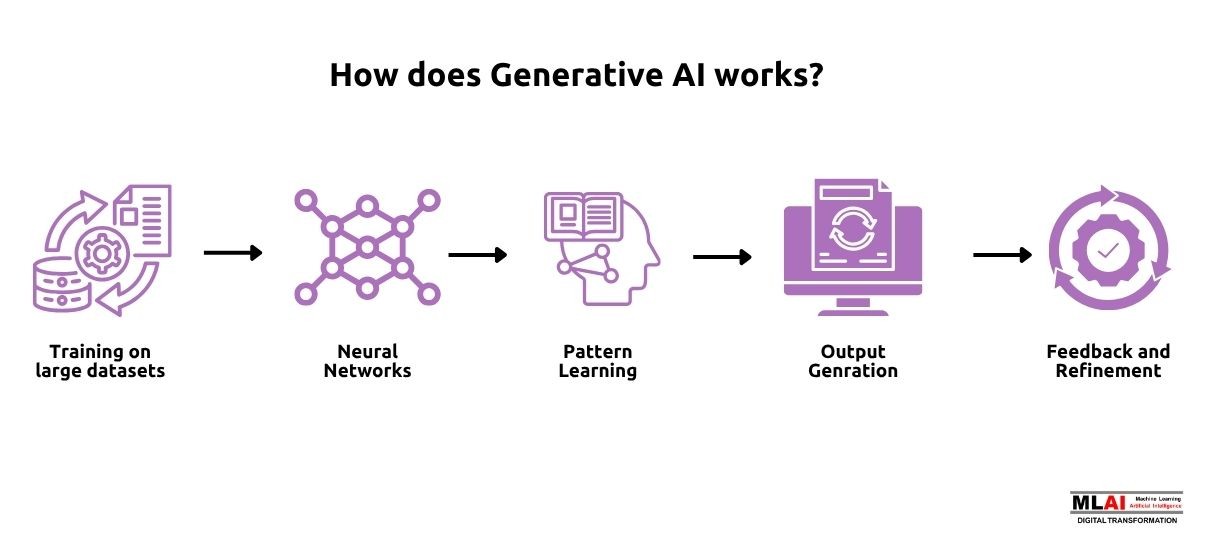
Now that you understand what is generative AI, let’s look at how generative AI works in a simple way.
At its core, generative AI uses advanced machine learning techniques, especially deep learning models and large language models (LLMs).
So, how does this actually work? Let’s look at it step by step:
2.1 Training on Large Data
First, the AI is trained on massive datasets. These datasets include text, images, videos, or code.
In simple terms, the AI is given a lot of examples to learn from. The more data it sees, the better it becomes at understanding how things work.
For example, a text-based AI learns from books, websites, and articles. This helps it understand language, tone, and structure.
2.2 Learning Patterns
Next, the AI studies patterns in the data.
In simple terms, it learns how different pieces of information are connected. It does not memorize the exact content but understands how things are usually formed.
For example, it learns:
How sentences are formed
How images are structured
How different elements connect
Because of this, the AI understands context instead of just memorizing information. It can also predict what should come next based on what it has learned.
2.3 Generating New Content
Finally, the AI uses these patterns to create new content.
When you give a prompt, the AI uses its learning to generate a fresh response. It tries to match the style, meaning, and structure based on your input.
For example:
If you ask it to write a blog, it generates a new article
If you give a prompt for an image, it creates a unique visual
Importantly, it does not copy content. Instead, it creates something original based on learned patterns, which is why every output can be different.
Simple Analogy
Think of generative AI like a student.
First, the student reads many books. Then, they learn how writing works. Finally, they write their own essay using what they learned.
This is exactly how generative AI works.
3.Real-Life Examples of Generative AI
To fully understand what is generative AI, it helps to look at generative AI examples in real life. These examples show how AI is already being used in everyday tasks.
3.1 Text Generation
One of the most popular uses of generative AI is text creation. Today, many people use AI tools to write and communicate faster.
Tools can:
Write blog posts
Generate emails
Answer questions
Create social media content
For example, a digital marketer can use AI to write Instagram captions or ad copy in seconds. Similarly, students use tools like ChatGPT to understand topics or draft assignments.
Because of this, writing has become faster and easier for both beginners and professionals.
3.2 Image Generation
Generative AI can also create images from simple text descriptions. This is very useful for designers, marketers, and content creators.
For example:
You type: “A futuristic city at sunset”
The AI generates a realistic image
In real life, businesses use this to create product images, social media posts, and ads without hiring a designer every time.
Popular tools include Midjourney and DALL·E. These tools help people turn ideas into visuals quickly.
3.3 Video and Audio Creation
AI is now being used to create videos and audio content, which was once time-consuming and expensive.
For example:
You can turn a blog into a video using AI tools
You can create voiceovers without recording your own voice
You can generate background music for videos
In real life, YouTubers and content creators use AI to produce videos faster. Businesses also use AI voice tools for customer support and marketing videos.
Because of this, content creation is becoming faster and more accessible.
3.4 Code Generation
Developers also use generative AI to write and improve code. This is especially helpful for beginners and busy developers.
For example:
A developer can ask AI to write a function in seconds
AI can help fix errors in code
It can suggest better ways to write programs
In real life, tools like GitHub Copilot help programmers build apps faster. Even beginners can create simple projects without deep coding knowledge.
This helps programmers save time and increase productivity.
These generative AI examples in real life clearly show how powerful and useful this technology has become. As a result, generative AI is now being used in almost every industry.
4.Benefits of Generative AI
Now that you know what is generative AI, let’s explore the benefits of generative AI in simple terms. These benefits explain why this technology is becoming so popular.
4.1 Saves Time
Generative AI can complete tasks in seconds that would normally take hours. This helps people work faster and meet deadlines easily.
For example, writing a blog, creating an email, or designing an image becomes much quicker with AI tools. Because of this, businesses and individuals can save a lot of time every day.
4.2 Improves Creativity
Generative AI can suggest new ideas that you may not think of on your own. It helps you explore different styles, formats, and approaches.
For example, a content creator can use AI to generate blog ideas or social media posts. As a result, it becomes easier to create fresh and engaging content.
4.3 Automates Repetitive Tasks
Generative AI can handle repetitive tasks like writing emails, creating reports, or generating basic content. This reduces manual effort.
For example, customer support teams can use AI to reply to common questions automatically. Because of this, people can focus on more important and creative work.
4.4 Scales Content Creation
Businesses can create large amounts of content in a short time using generative AI. This is very useful for marketing and SEO.
For example, a company can generate multiple blog posts, product descriptions, and ads quickly. As a result, they can grow their online presence faster.
4.5 Easy to Use
Most generative AI tools are simple and user-friendly. You just need to enter a prompt, and the AI will generate the output.
For example, even beginners can create content without technical knowledge. Because of this, generative AI is accessible to almost everyone.
5.Applications of Generative AI
The applications of generative AI are growing across many industries. Today, businesses and individuals are using AI to improve efficiency, reduce effort, and create better content.
5.1 Marketing and Content Creation
Businesses use generative AI to create content quickly and at scale. This helps them save time and improve their online presence.
AI is used to:
Write blogs
Create ads
Generate social media posts
For example, a marketing team can use AI to generate multiple ad copies or Instagram captions in minutes. Because of this, companies can run campaigns faster and test more ideas easily.
5.2 Healthcare
Generative AI is also being used in healthcare to support doctors and researchers. It helps in improving accuracy and saving time.
AI helps in:
Medical research
Drug discovery
Generating reports
For example, researchers use AI to study large amounts of medical data and find patterns. As a result, new treatments and medicines can be developed faster.
5.3 Education
Students and teachers are using generative AI to make learning easier and more interactive. It helps simplify complex topics and improve understanding.
AI is used for:
Learning assistance
Content creation
Simplifying complex topics
For example, a student can ask AI to explain a difficult concept in simple words. Because of this, learning becomes more accessible for everyone.
5.4 Software Development
Developers use generative AI tools to speed up the development process. It helps them write better code and reduce errors.
AI is used to:
Write code
Build applications
Automate testing
For example, a developer can use AI to generate code snippets or fix bugs quickly. As a result, projects can be completed faster and with fewer mistakes.
5.5 E-commerce
In e-commerce, generative AI helps businesses improve customer experience and increase sales. It makes content creation and personalization easier.
AI is used to:
Create product descriptions
Generate marketing content
Improve customer experience
For example, an online store can use AI to write product descriptions for hundreds of items in minutes. Because of this, businesses can scale faster and provide better service to customers.
Because of these real-world use cases, generative AI is becoming a key part of modern business. As technology continues to grow, its applications will expand even further.
6.Generative AI vs Traditional AI
To better understand what is generative AI, it helps to compare it with traditional AI.
Feature | Traditional AI | Generative AI |
Purpose | Analyze data and make decisions | Create new content |
Output | Predictions and recommendations | Text, images, videos, or code |
Data Usage | Works mostly with structured data | Uses large and diverse datasets |
Creativity | Limited creativity | High creativity |
Examples | Spam detection, fraud detection | Chatbots, image generators |
Traditional AI tells you what might happen
Generative AI creates something new
7.Challenges and Limitations of Generative AI
While generative AI is powerful, it also has some challenges and limitations. Understanding these issues is important so we can use AI in a safe and responsible way.
7.1 AI Hallucinations
Sometimes, generative AI produces information that is incorrect or misleading. This is known as AI hallucination.
For example, an AI tool might give a wrong answer or create facts that do not exist. Because of this, it is important to always verify important information before using it.
7.2 Data Privacy Concerns
Generative AI systems are trained on large amounts of data, which may include sensitive information. This can raise privacy and security concerns.
For example, if not handled properly, user data could be exposed or misused. Therefore, companies need to follow strict data protection rules when using AI.
7.3 Bias in Outputs
If the data used to train AI is biased, the AI can also produce biased results. This can affect fairness and accuracy.
For example, AI might favor certain viewpoints or give unbalanced responses. Because of this, it is important to train AI on diverse and balanced datasets.
7.4 Overdependence on AI
Relying too much on generative AI can reduce human creativity and critical thinking. People may start depending on AI for tasks they can do themselves.
For example, students may rely on AI to complete assignments instead of learning the concepts. As a result, it is important to use AI as a support tool, not a complete replacement.
Because of these challenges and limitations, it is important to use generative AI responsibly. When used carefully, it can be very helpful, but it should always be combined with human judgment.
8.Is Generative AI the Future?
After understanding what is generative AI, it’s clear that this technology is shaping the future.
Generative AI is already being used in:
Businesses
Education
Content creation
Software development
As technology improves, AI will become even more powerful and widely used.
However, the future is not just about AI replacing humans. Instead, it is about humans and AI working together.
Conclusion
So, what is generative AI? It is a powerful type of artificial intelligence that can create new content such as text, images, videos, and code.
Unlike traditional AI, which focuses on analysis, generative AI focuses on creation. Because of this, it is transforming industries and changing how people work and create content.
As generative AI continues to evolve, it will play an even bigger role in our daily lives. Therefore, understanding this technology is no longer optional; it is essential.
If you want to learn more about advanced AI topics like AI agents, RAG architecture, or prompt engineering, explore our other guides to stay ahead in the AI world.
Generative AI is changing how we create content online. Today, tools can write articles, generate images, create videos, and even help with coding in just a few seconds. Because of this, many people are asking a simple question: what is generative AI and how does it actually work?
Generative AI is a type of artificial intelligence that creates new content such as text, images, videos, or code. Instead of just analyzing data, it produces something new based on what it has learned.
For example, tools like ChatGPT can write blogs or answer questions, while platforms like Midjourney and DALL·E can create realistic images from simple text prompts. These tools are not copying content. Instead, they generate original outputs using patterns learned from large datasets.
In this guide, you will learn what is generative AI in simple terms, how generative AI works, and see real-life generative AI examples that make everything easy to understand.
1.What is Generative AI in Simple Terms?
Let’s break down what is generative AI in the simplest way possible.
In simple terms, generative AI is a technology that can create new content instead of just analyzing existing data. This is what makes it different from traditional AI systems.
Earlier, most AI systems were designed to recognize patterns or make predictions. For example, they could recommend movies or detect spam emails. However, they could not create something entirely new.
On the other hand, generative AI can:
Write articles
Generate images
Create music
Produce videos
Even write code
Because of this, the generative AI meaning is closely linked to creativity and content generation.
Another way to understand the generative AI definition is this:
Generative AI learns from data and then uses that knowledge to create new, original outputs.
This is why tools powered by generative AI feel more “human-like” compared to older AI systems.
2.How Does Generative AI Work?
Now that you understand what is generative AI, let’s look at how generative AI works in a simple way.
At its core, generative AI uses advanced machine learning techniques, especially deep learning models and large language models (LLMs).
So, how does this actually work? Let’s look at it step by step:
2.1 Training on Large Data
First, the AI is trained on massive datasets. These datasets include text, images, videos, or code.
In simple terms, the AI is given a lot of examples to learn from. The more data it sees, the better it becomes at understanding how things work.
For example, a text-based AI learns from books, websites, and articles. This helps it understand language, tone, and structure.
2.2 Learning Patterns
Next, the AI studies patterns in the data.
In simple terms, it learns how different pieces of information are connected. It does not memorize the exact content but understands how things are usually formed.
For example, it learns:
How sentences are formed
How images are structured
How different elements connect
Because of this, the AI understands context instead of just memorizing information. It can also predict what should come next based on what it has learned.
2.3 Generating New Content
Finally, the AI uses these patterns to create new content.
When you give a prompt, the AI uses its learning to generate a fresh response. It tries to match the style, meaning, and structure based on your input.
For example:
If you ask it to write a blog, it generates a new article
If you give a prompt for an image, it creates a unique visual
Importantly, it does not copy content. Instead, it creates something original based on learned patterns, which is why every output can be different.
Simple Analogy
Think of generative AI like a student.
First, the student reads many books. Then, they learn how writing works. Finally, they write their own essay using what they learned.
This is exactly how generative AI works.
3.Real-Life Examples of Generative AI
To fully understand what is generative AI, it helps to look at generative AI examples in real life. These examples show how AI is already being used in everyday tasks.
3.1 Text Generation
One of the most popular uses of generative AI is text creation. Today, many people use AI tools to write and communicate faster.
Tools can:
Write blog posts
Generate emails
Answer questions
Create social media content
For example, a digital marketer can use AI to write Instagram captions or ad copy in seconds. Similarly, students use tools like ChatGPT to understand topics or draft assignments.
Because of this, writing has become faster and easier for both beginners and professionals.
3.2 Image Generation
Generative AI can also create images from simple text descriptions. This is very useful for designers, marketers, and content creators.
For example:
You type: “A futuristic city at sunset”
The AI generates a realistic image
In real life, businesses use this to create product images, social media posts, and ads without hiring a designer every time.
Popular tools include Midjourney and DALL·E. These tools help people turn ideas into visuals quickly.
3.3 Video and Audio Creation
AI is now being used to create videos and audio content, which was once time-consuming and expensive.
For example:
You can turn a blog into a video using AI tools
You can create voiceovers without recording your own voice
You can generate background music for videos
In real life, YouTubers and content creators use AI to produce videos faster. Businesses also use AI voice tools for customer support and marketing videos.
Because of this, content creation is becoming faster and more accessible.
3.4 Code Generation
Developers also use generative AI to write and improve code. This is especially helpful for beginners and busy developers.
For example:
A developer can ask AI to write a function in seconds
AI can help fix errors in code
It can suggest better ways to write programs
In real life, tools like GitHub Copilot help programmers build apps faster. Even beginners can create simple projects without deep coding knowledge.
This helps programmers save time and increase productivity.
These generative AI examples in real life clearly show how powerful and useful this technology has become. As a result, generative AI is now being used in almost every industry.
4.Benefits of Generative AI
Now that you know what is generative AI, let’s explore the benefits of generative AI in simple terms. These benefits explain why this technology is becoming so popular.
4.1 Saves Time
Generative AI can complete tasks in seconds that would normally take hours. This helps people work faster and meet deadlines easily.
For example, writing a blog, creating an email, or designing an image becomes much quicker with AI tools. Because of this, businesses and individuals can save a lot of time every day.
4.2 Improves Creativity
Generative AI can suggest new ideas that you may not think of on your own. It helps you explore different styles, formats, and approaches.
For example, a content creator can use AI to generate blog ideas or social media posts. As a result, it becomes easier to create fresh and engaging content.
4.3 Automates Repetitive Tasks
Generative AI can handle repetitive tasks like writing emails, creating reports, or generating basic content. This reduces manual effort.
For example, customer support teams can use AI to reply to common questions automatically. Because of this, people can focus on more important and creative work.
4.4 Scales Content Creation
Businesses can create large amounts of content in a short time using generative AI. This is very useful for marketing and SEO.
For example, a company can generate multiple blog posts, product descriptions, and ads quickly. As a result, they can grow their online presence faster.
4.5 Easy to Use
Most generative AI tools are simple and user-friendly. You just need to enter a prompt, and the AI will generate the output.
For example, even beginners can create content without technical knowledge. Because of this, generative AI is accessible to almost everyone.
5.Applications of Generative AI
The applications of generative AI are growing across many industries. Today, businesses and individuals are using AI to improve efficiency, reduce effort, and create better content.
5.1 Marketing and Content Creation
Businesses use generative AI to create content quickly and at scale. This helps them save time and improve their online presence.
AI is used to:
Write blogs
Create ads
Generate social media posts
For example, a marketing team can use AI to generate multiple ad copies or Instagram captions in minutes. Because of this, companies can run campaigns faster and test more ideas easily.
5.2 Healthcare
Generative AI is also being used in healthcare to support doctors and researchers. It helps in improving accuracy and saving time.
AI helps in:
Medical research
Drug discovery
Generating reports
For example, researchers use AI to study large amounts of medical data and find patterns. As a result, new treatments and medicines can be developed faster.
5.3 Education
Students and teachers are using generative AI to make learning easier and more interactive. It helps simplify complex topics and improve understanding.
AI is used for:
Learning assistance
Content creation
Simplifying complex topics
For example, a student can ask AI to explain a difficult concept in simple words. Because of this, learning becomes more accessible for everyone.
5.4 Software Development
Developers use generative AI tools to speed up the development process. It helps them write better code and reduce errors.
AI is used to:
Write code
Build applications
Automate testing
For example, a developer can use AI to generate code snippets or fix bugs quickly. As a result, projects can be completed faster and with fewer mistakes.
5.5 E-commerce
In e-commerce, generative AI helps businesses improve customer experience and increase sales. It makes content creation and personalization easier.
AI is used to:
Create product descriptions
Generate marketing content
Improve customer experience
For example, an online store can use AI to write product descriptions for hundreds of items in minutes. Because of this, businesses can scale faster and provide better service to customers.
Because of these real-world use cases, generative AI is becoming a key part of modern business. As technology continues to grow, its applications will expand even further.
6.Generative AI vs Traditional AI
To better understand what is generative AI, it helps to compare it with traditional AI.
Feature | Traditional AI | Generative AI |
Purpose | Analyze data and make decisions | Create new content |
Output | Predictions and recommendations | Text, images, videos, or code |
Data Usage | Works mostly with structured data | Uses large and diverse datasets |
Creativity | Limited creativity | High creativity |
Examples | Spam detection, fraud detection | Chatbots, image generators |
Traditional AI tells you what might happen
Generative AI creates something new
7.Challenges and Limitations of Generative AI
While generative AI is powerful, it also has some challenges and limitations. Understanding these issues is important so we can use AI in a safe and responsible way.
7.1 AI Hallucinations
Sometimes, generative AI produces information that is incorrect or misleading. This is known as AI hallucination.
For example, an AI tool might give a wrong answer or create facts that do not exist. Because of this, it is important to always verify important information before using it.
7.2 Data Privacy Concerns
Generative AI systems are trained on large amounts of data, which may include sensitive information. This can raise privacy and security concerns.
For example, if not handled properly, user data could be exposed or misused. Therefore, companies need to follow strict data protection rules when using AI.
7.3 Bias in Outputs
If the data used to train AI is biased, the AI can also produce biased results. This can affect fairness and accuracy.
For example, AI might favor certain viewpoints or give unbalanced responses. Because of this, it is important to train AI on diverse and balanced datasets.
7.4 Overdependence on AI
Relying too much on generative AI can reduce human creativity and critical thinking. People may start depending on AI for tasks they can do themselves.
For example, students may rely on AI to complete assignments instead of learning the concepts. As a result, it is important to use AI as a support tool, not a complete replacement.
Because of these challenges and limitations, it is important to use generative AI responsibly. When used carefully, it can be very helpful, but it should always be combined with human judgment.
8.Is Generative AI the Future?
After understanding what is generative AI, it’s clear that this technology is shaping the future.
Generative AI is already being used in:
Businesses
Education
Content creation
Software development
As technology improves, AI will become even more powerful and widely used.
However, the future is not just about AI replacing humans. Instead, it is about humans and AI working together.
Conclusion
So, what is generative AI? It is a powerful type of artificial intelligence that can create new content such as text, images, videos, and code.
Unlike traditional AI, which focuses on analysis, generative AI focuses on creation. Because of this, it is transforming industries and changing how people work and create content.
As generative AI continues to evolve, it will play an even bigger role in our daily lives. Therefore, understanding this technology is no longer optional; it is essential.
If you want to learn more about advanced AI topics like AI agents, RAG architecture, or prompt engineering, explore our other guides to stay ahead in the AI world.
Related Blogs
Be the first to read our articles.

