


Generative AI vs Agentic AI: What Sets Them Apart | MLAI Digital
Prerna Sahni
Generative AI
1.Introduction
Agentic AI vs Generative AI? It’s likely that you have heard both terminology thrown around in tech talks, boardrooms and product roadmaps if you have been following fast-paced AI. A lot of companies still don’t know how the two differ and, furthermore, when to use each.
Generative AI tools have impressed the world with their ability to produce content, code and designs at the press of a button. Meanwhile, agentic AI is changing systems that think, plan and act on their own. It has a great difference, and it is strategic. At MLAI Digital, we’ve seen firsthand how organizations gain a competitive edge once they understand how to apply both technologies effectively.
In this blog, we will examine the actual difference between Agentic AI vs Generative AI, step through some practical agentic AI examples, compare real world use case, and clear up the agentic AI vs generative AI differences in a way that actually makes sense.
2.What Is Generative AI?
Generative AI describes systems that create new content like text, imagery, audio, video or code by learning patterns from massive amounts of data. These models do not “think” like humans do; rather they predict the next output that is statistically most probable, given the prompts.
When you ask a generative AI tool to:
Write a blog post
Generate marketing copy
Create a product description
Summarize a document
Produce an image
…it responds with a one-shot output. You give input; it gives output. That’s the loop.
Key Characteristics of Generative AI
Prompt-driven interaction
Content creation focused
Reactive, not autonomous
Limited memory across sessions
No independent goal execution
It excels at creativity and language fluency but does not independently plan tasks or execute workflows beyond the scope of a single response.
3.What Is Agentic AI?
Agentic AI elevates intelligence a notch further. It can generate tasks and plan things, make decisions, and execute multi-step workflows with little human intervention instead of only producing output.
In simple terms:
Generative AI creates.
Agentic AI acts.
Agentic AI systems are often described as autonomous AI agents because they can operate independently within defined boundaries. They don’t just respond—they initiate actions.
Core Traits of Agentic AI
Goal-oriented behavior
AI planning and execution
Multi-step reasoning
Tool usage (APIs, databases, software)
Adaptive decision-making
Agentic AI cannot handle a single prompt like a generative system. However, it can break down a single objective into multiple sequential tasks. Furthermore, it can modify and mend issues along the way. To sum up, agentic AI can output a single result in the end.
This is where the real transformation begins.
4.Agentic AI vs Generative AI: Core Differences
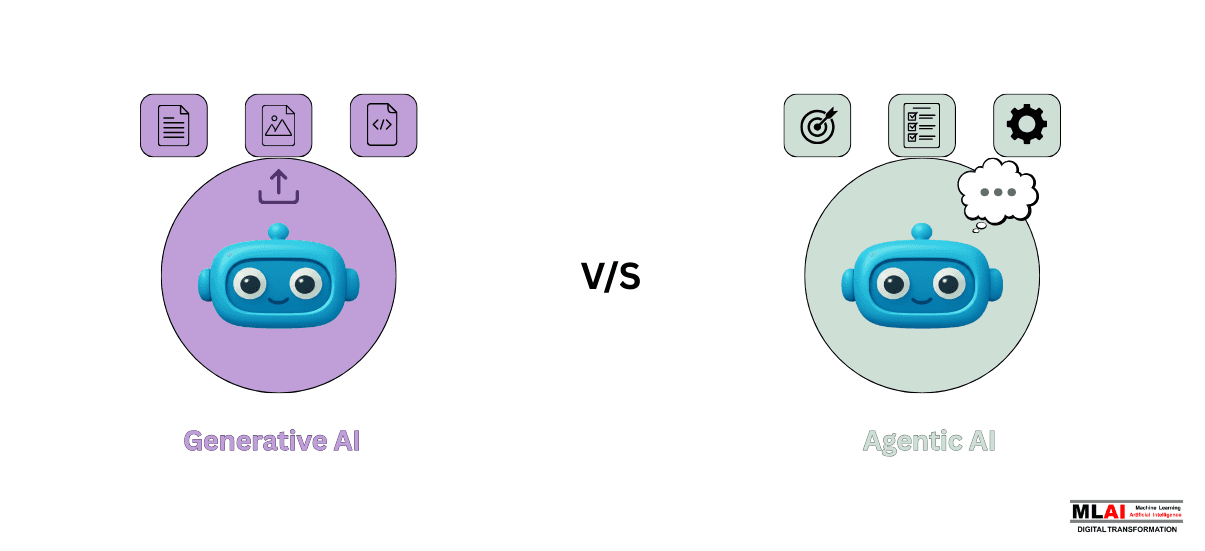
Understanding the agentic AI vs generative AI differences requires looking at behavior, not just architecture.
4.1. Output vs Action
Generative AI produces content.
Agentic AI performs tasks.
For example, generative AI can draft a sales email. Agentic AI can identify prospects, personalize emails, schedule outreach, track responses, and optimize follow-ups.
4.2. Single-Step vs Multi-Step Reasoning
Generative AI typically operates in a single-step response cycle.
Agentic AI uses multi-step reasoning to break down complex objectives into executable subtasks.
4.3. Reactive vs Proactive
Generative AI waits for instructions.
Agentic AI systems can initiate processes based on triggers, data changes, or defined goals.
4.4. No Memory vs Contextual Continuity
Generative AI tools often lack persistent memory unless specifically engineered.
Agentic systems can maintain context across tasks, improving long-term performance.
4.5. Content Creation vs Workflow Automation
The most practical way to understand Agentic AI vs Generative AI is this:
Generative AI enhances productivity.
Agentic AI transforms operations.
5.Real-World Examples of Generative AI
To better understand the contrast, let’s look at real-world applications.
5.1. Content Marketing
Businesses use generative AI to:
Write blogs
Draft newsletters
Create social media posts
Generate ad copy
It accelerates creative processes considerably as the time spent in brainstorming and drafting reduces. With the help of multiple content variations, the marketing teams can quickly experiment with tone and scale it across audiences. Nonetheless, a human review is still required to make sure accuracy, consistency, and strategic alignment.
5.2. Code Assistance
Developers use generative AI to:
Suggest code snippets
Debug errors
Convert logic between programming languages
The tool is like a productivity co-pilot for engineers to speedily write boilerplate code or learn new frameworks. This generative AI can explain complicated blocks of code and suggest optimizations for code. Nonetheless, developers should always verify output, testing, and security compliance before launching.
5.3. Customer Support Drafting
AI generates response templates for customer service teams.
Depending upon ticket categories, customer history, or sentiment analysis, it can customize responses. Leads to faster response times and upholds standards of communication. Nonetheless, customer care agents can review, modify, and approve messages for customers.
These are powerful capabilities, but they stop at creation. The system does not independently execute tasks beyond generating the requested output.
6.Real-World Examples of Agentic AI
Now let’s look at agentic AI examples that highlight how these systems go beyond content creation.
6.1. Autonomous Sales Agents
An agentic AI system can:
Identify qualified leads
Research company data
Personalize outreach
Send follow-up emails
Schedule meetings
Update CRM records
Everything happens without an order given at each step. The system makes decisions based on set goals, like improving conversion rates or focusing on high-value accounts. It keeps adjusting its outreach strategy based on the replies, signals, and metrics.
6.2. Supply Chain Optimization
An agentic AI can monitor inventory levels, predict demand, place purchase orders, and adjust logistics routes automatically.
It examines data from suppliers, warehouses, and transport systems in real time to predict. The system can move resources or switch vendors if there are shortages or delays. It removes operational risk, lowers costs without dependence constantly on human support.
6.3. Financial Operations
It can reconcile transactions, flag anomalies, prepare reports, and notify stakeholders using AI planning and execution to manage end-to-end workflows.
Instead of simply generating financial summaries, the system actively monitors financial streams and enforces compliance rules. When discrepancies arise, it can initiate corrective workflows, request documentation, or escalate issues based on severity thresholds.
6.4. IT Incident Management
Autonomous AI agents can detect server issues, run diagnostics, deploy fixes, and escalate only when human input is necessary.
The performance and safety alerts of the system are monitored regularly. When anything goes wrong, the agent can isolate services, roll back, or restart infrastructure automatically. As a result, downtime is reduced while IT teams can focus on strategic initiatives as opposed to repetitive troubleshooting.
7.Same Task, Two Approaches (Side-by-Side Example)
Let’s compare Agentic AI vs Generative AI using a marketing campaign example.
Scenario: Launching a New Product
Generative AI Approach
You prompt the AI to:
Write a landing page
Create email sequences
Generate ad headlines
It produces the content. You manually handle everything else.
Agentic AI Approach
An agentic system would:
Research competitor positioning
Analyze audience segments
Generate messaging variants
A/B test ads
Adjust budget allocation
Track conversions
Optimize performance continuously
This highlights the fundamental difference in the agentic AI vs generative AI differences: one creates assets, the other manages strategy and execution.
8.When Should You Use Generative AI vs Agentic AI?
Choosing between them depends on your goal.
Use Generative AI When:
You need fast content production
Creativity is the primary objective
Tasks are isolated and one-step
Human oversight is required at every stage
Use Agentic AI When:
Tasks involve multiple steps
You want automation beyond content
Decisions must adapt dynamically
Continuous optimization is required
Many organizations benefit from combining both. Generative AI can power content creation inside larger agentic workflows.
This is why the debate around Agentic AI vs Generative AI shouldn’t focus on replacement but collaboration.
9.Common Misconceptions About Agentic AI
Misconception 1: It Replaces Humans Completely
Agentic AI enhances human decision-making. It doesn’t eliminate strategic oversight.
In most real-world scenarios, the goals, constraints, and approval thresholds remain human-defined. AI takes over repetitive, data-intensive, or time-critical tasks, allowing humans to concentrate on strategy, creativity, and ethics. Rather than taking-over specialists’ jobs, agentic AI usually reallocates them to higher-value work and supervision.
Misconception 2: It’s Just Advanced Automation
Traditional automation follows fixed rules. Agentic AI uses multi-step reasoning and adaptive logic.
A basic automation only executes the pre-defined ‘if-then’ instructions and can’t skid off the scripted workflow. Nonetheless, agentic AI can assess changing conditions, make contextual decisions, and revise its patterns of behavior. It is able to plan action sequences, make use of various tools, and update its strategies when new information arises.
Misconception 3: It’s the Same as Generative AI
This confusion fuels most misunderstandings about Agentic AI vs Generative AI. Generative systems don’t independently execute tasks across tools and environments.
Generative AI is capable of producing various outputs such as text, images, and even codes. When finished, it stops (unless human told to do something else). In contrast, agentic AI can initiate actions within certain constraints, link actions together, and converse with software systems, working towards an end goal without constant prodding.
Misconception 4: It’s Too Risky to Deploy
With proper guardrails, monitoring systems, and defined scopes, autonomous AI agents can operate safely within controlled environments.
The risk involved with any sophisticated system is a function of its design and governance. Usually organizations implement layers of permissions, logging, human-in-the-loop approval, performance monitoring for accountability. Agentic AI can minimize human error, streamline processes, ensure consistent delivery and respond to issues quicker than human processes when used responsibly.
10.Why Agentic AI Is the Next Step (Not a Replacement)
Agentic AI builds on generative foundations. It often uses generative models internally for communication and reasoning. The difference lies in orchestration.
Think of generative AI as a skilled writer.
Think of agentic AI as a project manager who can write, plan, coordinate, execute, and evaluate outcomes.
As businesses scale, the need shifts from creation to coordination. This is where AI planning and execution become essential.
The rise of autonomous AI agents signals a shift toward systems that don’t just assist but actively drive outcomes.
Understanding Agentic AI vs Generative AI at this stage is critical because the organizations that implement agentic systems thoughtfully will redefine operational efficiency.
11.The Future: Convergence of Creation and Action
The future isn’t about choosing sides in the Agentic AI vs Generative AI debate. It’s about integration.
Imagine:
Generative AI drafting personalized communication
Agentic AI deploying, testing, and optimizing it
Continuous learning loops improving performance
Cross-platform orchestration happening autonomously
That’s not theoretical; it’s already happening.
The next wave of innovation will combine creativity with execution, powered by agentic AI examples that demonstrate measurable ROI.
Conclusion
The discourse on Agentic AI and Generative AI isn't about which one is better, but their roles are in the future Generative AI quickly and efficiently creates content. Agentic AI utilizes multi-tier reasoning and AI planning and execution as goal-driven action. As generative AIs enhance creativity and increase productivity, agentic systems for autonomous AI agents manage increasingly complex workflows with reasonable autonomy. Companies that take a dual approach to creativity, implementation, and optimization have scale advantages. The future of AI lies in the intelligent collaboration of generative and agentic intelligence rather than the replacement of one another.
1.Introduction
Agentic AI vs Generative AI? It’s likely that you have heard both terminology thrown around in tech talks, boardrooms and product roadmaps if you have been following fast-paced AI. A lot of companies still don’t know how the two differ and, furthermore, when to use each.
Generative AI tools have impressed the world with their ability to produce content, code and designs at the press of a button. Meanwhile, agentic AI is changing systems that think, plan and act on their own. It has a great difference, and it is strategic. At MLAI Digital, we’ve seen firsthand how organizations gain a competitive edge once they understand how to apply both technologies effectively.
In this blog, we will examine the actual difference between Agentic AI vs Generative AI, step through some practical agentic AI examples, compare real world use case, and clear up the agentic AI vs generative AI differences in a way that actually makes sense.
2.What Is Generative AI?
Generative AI describes systems that create new content like text, imagery, audio, video or code by learning patterns from massive amounts of data. These models do not “think” like humans do; rather they predict the next output that is statistically most probable, given the prompts.
When you ask a generative AI tool to:
Write a blog post
Generate marketing copy
Create a product description
Summarize a document
Produce an image
…it responds with a one-shot output. You give input; it gives output. That’s the loop.
Key Characteristics of Generative AI
Prompt-driven interaction
Content creation focused
Reactive, not autonomous
Limited memory across sessions
No independent goal execution
It excels at creativity and language fluency but does not independently plan tasks or execute workflows beyond the scope of a single response.
3.What Is Agentic AI?
Agentic AI elevates intelligence a notch further. It can generate tasks and plan things, make decisions, and execute multi-step workflows with little human intervention instead of only producing output.
In simple terms:
Generative AI creates.
Agentic AI acts.
Agentic AI systems are often described as autonomous AI agents because they can operate independently within defined boundaries. They don’t just respond—they initiate actions.
Core Traits of Agentic AI
Goal-oriented behavior
AI planning and execution
Multi-step reasoning
Tool usage (APIs, databases, software)
Adaptive decision-making
Agentic AI cannot handle a single prompt like a generative system. However, it can break down a single objective into multiple sequential tasks. Furthermore, it can modify and mend issues along the way. To sum up, agentic AI can output a single result in the end.
This is where the real transformation begins.
4.Agentic AI vs Generative AI: Core Differences
Understanding the agentic AI vs generative AI differences requires looking at behavior, not just architecture.
4.1. Output vs Action
Generative AI produces content.
Agentic AI performs tasks.
For example, generative AI can draft a sales email. Agentic AI can identify prospects, personalize emails, schedule outreach, track responses, and optimize follow-ups.
4.2. Single-Step vs Multi-Step Reasoning
Generative AI typically operates in a single-step response cycle.
Agentic AI uses multi-step reasoning to break down complex objectives into executable subtasks.
4.3. Reactive vs Proactive
Generative AI waits for instructions.
Agentic AI systems can initiate processes based on triggers, data changes, or defined goals.
4.4. No Memory vs Contextual Continuity
Generative AI tools often lack persistent memory unless specifically engineered.
Agentic systems can maintain context across tasks, improving long-term performance.
4.5. Content Creation vs Workflow Automation
The most practical way to understand Agentic AI vs Generative AI is this:
Generative AI enhances productivity.
Agentic AI transforms operations.
5.Real-World Examples of Generative AI
To better understand the contrast, let’s look at real-world applications.
5.1. Content Marketing
Businesses use generative AI to:
Write blogs
Draft newsletters
Create social media posts
Generate ad copy
It accelerates creative processes considerably as the time spent in brainstorming and drafting reduces. With the help of multiple content variations, the marketing teams can quickly experiment with tone and scale it across audiences. Nonetheless, a human review is still required to make sure accuracy, consistency, and strategic alignment.
5.2. Code Assistance
Developers use generative AI to:
Suggest code snippets
Debug errors
Convert logic between programming languages
The tool is like a productivity co-pilot for engineers to speedily write boilerplate code or learn new frameworks. This generative AI can explain complicated blocks of code and suggest optimizations for code. Nonetheless, developers should always verify output, testing, and security compliance before launching.
5.3. Customer Support Drafting
AI generates response templates for customer service teams.
Depending upon ticket categories, customer history, or sentiment analysis, it can customize responses. Leads to faster response times and upholds standards of communication. Nonetheless, customer care agents can review, modify, and approve messages for customers.
These are powerful capabilities, but they stop at creation. The system does not independently execute tasks beyond generating the requested output.
6.Real-World Examples of Agentic AI
Now let’s look at agentic AI examples that highlight how these systems go beyond content creation.
6.1. Autonomous Sales Agents
An agentic AI system can:
Identify qualified leads
Research company data
Personalize outreach
Send follow-up emails
Schedule meetings
Update CRM records
Everything happens without an order given at each step. The system makes decisions based on set goals, like improving conversion rates or focusing on high-value accounts. It keeps adjusting its outreach strategy based on the replies, signals, and metrics.
6.2. Supply Chain Optimization
An agentic AI can monitor inventory levels, predict demand, place purchase orders, and adjust logistics routes automatically.
It examines data from suppliers, warehouses, and transport systems in real time to predict. The system can move resources or switch vendors if there are shortages or delays. It removes operational risk, lowers costs without dependence constantly on human support.
6.3. Financial Operations
It can reconcile transactions, flag anomalies, prepare reports, and notify stakeholders using AI planning and execution to manage end-to-end workflows.
Instead of simply generating financial summaries, the system actively monitors financial streams and enforces compliance rules. When discrepancies arise, it can initiate corrective workflows, request documentation, or escalate issues based on severity thresholds.
6.4. IT Incident Management
Autonomous AI agents can detect server issues, run diagnostics, deploy fixes, and escalate only when human input is necessary.
The performance and safety alerts of the system are monitored regularly. When anything goes wrong, the agent can isolate services, roll back, or restart infrastructure automatically. As a result, downtime is reduced while IT teams can focus on strategic initiatives as opposed to repetitive troubleshooting.
7.Same Task, Two Approaches (Side-by-Side Example)
Let’s compare Agentic AI vs Generative AI using a marketing campaign example.
Scenario: Launching a New Product
Generative AI Approach
You prompt the AI to:
Write a landing page
Create email sequences
Generate ad headlines
It produces the content. You manually handle everything else.
Agentic AI Approach
An agentic system would:
Research competitor positioning
Analyze audience segments
Generate messaging variants
A/B test ads
Adjust budget allocation
Track conversions
Optimize performance continuously
This highlights the fundamental difference in the agentic AI vs generative AI differences: one creates assets, the other manages strategy and execution.
8.When Should You Use Generative AI vs Agentic AI?
Choosing between them depends on your goal.
Use Generative AI When:
You need fast content production
Creativity is the primary objective
Tasks are isolated and one-step
Human oversight is required at every stage
Use Agentic AI When:
Tasks involve multiple steps
You want automation beyond content
Decisions must adapt dynamically
Continuous optimization is required
Many organizations benefit from combining both. Generative AI can power content creation inside larger agentic workflows.
This is why the debate around Agentic AI vs Generative AI shouldn’t focus on replacement but collaboration.
9.Common Misconceptions About Agentic AI
Misconception 1: It Replaces Humans Completely
Agentic AI enhances human decision-making. It doesn’t eliminate strategic oversight.
In most real-world scenarios, the goals, constraints, and approval thresholds remain human-defined. AI takes over repetitive, data-intensive, or time-critical tasks, allowing humans to concentrate on strategy, creativity, and ethics. Rather than taking-over specialists’ jobs, agentic AI usually reallocates them to higher-value work and supervision.
Misconception 2: It’s Just Advanced Automation
Traditional automation follows fixed rules. Agentic AI uses multi-step reasoning and adaptive logic.
A basic automation only executes the pre-defined ‘if-then’ instructions and can’t skid off the scripted workflow. Nonetheless, agentic AI can assess changing conditions, make contextual decisions, and revise its patterns of behavior. It is able to plan action sequences, make use of various tools, and update its strategies when new information arises.
Misconception 3: It’s the Same as Generative AI
This confusion fuels most misunderstandings about Agentic AI vs Generative AI. Generative systems don’t independently execute tasks across tools and environments.
Generative AI is capable of producing various outputs such as text, images, and even codes. When finished, it stops (unless human told to do something else). In contrast, agentic AI can initiate actions within certain constraints, link actions together, and converse with software systems, working towards an end goal without constant prodding.
Misconception 4: It’s Too Risky to Deploy
With proper guardrails, monitoring systems, and defined scopes, autonomous AI agents can operate safely within controlled environments.
The risk involved with any sophisticated system is a function of its design and governance. Usually organizations implement layers of permissions, logging, human-in-the-loop approval, performance monitoring for accountability. Agentic AI can minimize human error, streamline processes, ensure consistent delivery and respond to issues quicker than human processes when used responsibly.
10.Why Agentic AI Is the Next Step (Not a Replacement)
Agentic AI builds on generative foundations. It often uses generative models internally for communication and reasoning. The difference lies in orchestration.
Think of generative AI as a skilled writer.
Think of agentic AI as a project manager who can write, plan, coordinate, execute, and evaluate outcomes.
As businesses scale, the need shifts from creation to coordination. This is where AI planning and execution become essential.
The rise of autonomous AI agents signals a shift toward systems that don’t just assist but actively drive outcomes.
Understanding Agentic AI vs Generative AI at this stage is critical because the organizations that implement agentic systems thoughtfully will redefine operational efficiency.
11.The Future: Convergence of Creation and Action
The future isn’t about choosing sides in the Agentic AI vs Generative AI debate. It’s about integration.
Imagine:
Generative AI drafting personalized communication
Agentic AI deploying, testing, and optimizing it
Continuous learning loops improving performance
Cross-platform orchestration happening autonomously
That’s not theoretical; it’s already happening.
The next wave of innovation will combine creativity with execution, powered by agentic AI examples that demonstrate measurable ROI.
Conclusion
The discourse on Agentic AI and Generative AI isn't about which one is better, but their roles are in the future Generative AI quickly and efficiently creates content. Agentic AI utilizes multi-tier reasoning and AI planning and execution as goal-driven action. As generative AIs enhance creativity and increase productivity, agentic systems for autonomous AI agents manage increasingly complex workflows with reasonable autonomy. Companies that take a dual approach to creativity, implementation, and optimization have scale advantages. The future of AI lies in the intelligent collaboration of generative and agentic intelligence rather than the replacement of one another.
Related Blogs
Be the first to read our articles.

