


AI Agent Governance: Secure & Manage Enterprise AI Agents

Prerna Sahni
AI Agents
1. Introduction
AI Agent Governance has quickly become one of the most important conversations in enterprise technology, and it arrived faster than most leadership teams expected. Just a couple of years ago, AI in the enterprise mostly meant a helpful chatbot. Today, AI agents book meetings, move money between systems, query sensitive databases, and make decisions that used to sit on a human's desk. The moment software stops merely suggesting and starts acting, the rules change completely, which is exactly why AI Agent Governance has moved from a nice-to-have to a boardroom priority.
The tension is simple: autonomy is where the value lives, but the same autonomy that makes agents useful also makes them risky. In this guide, we'll cover what AI Agent Governance actually means, why it matters more than ever, the real risks of leaving agents ungoverned, and a practical framework you can put to work, so you can keep innovation moving while staying firmly in control.
2. What Is AI Agent Governance?
At its simplest, AI Agent Governance is the set of policies, controls, and oversight mechanisms that decide what an AI agent is allowed to do, how it does it, and who is accountable when something goes wrong. Think of it as the operating rulebook for your digital workforce, except this workforce never sleeps and can act across dozens of systems at once.
Governance shapes agent behavior in very concrete ways. It defines which data an agent can touch, which tools it can call, how much autonomy it gets, and what happens when it steps outside approved boundaries. Instead of hoping an agent behaves, governance builds the guardrails that make good behavior the default and bad behavior nearly impossible.
It's worth separating a few ideas that often get blurred together. Traditional AI governance was largely about models, focusing on bias, fairness, training data, and explainability. That still matters, but agentic AI governance goes further because agents don't just predict; they act. You now have to govern the actions themselves, not only the outputs.
There's also a difference between governance and AI agent security. Security is about protecting the agent and the systems around it from threats, things like preventing prompt injection or unauthorized access. Governance is the wider umbrella that includes security but also covers ownership, accountability, compliance, and control. As agent autonomy climbs, this distinction stops being academic. The more an agent can do on its own, the more governance becomes the thing standing between a productive automation and an expensive incident.
3. Why Enterprises Need AI Agent Governance
3.1 The Business Challenge
Modern AI agents are deeply woven into the fabric of the enterprise, and that's precisely what makes them powerful and precarious at the same time. These agents routinely reach into enterprise data stores, pulling customer records, financial figures, and internal documents to do their jobs. They connect to business applications and APIs, meaning a single agent might touch your CRM, your payment gateway, and your ticketing system within seconds.
Now layer autonomous decision-making on top of all that. When an agent independently approves a refund, flags a transaction, or routes a claim, it's making choices inside workflows that carry real financial and legal weight. That's a remarkable capability, but without structure around it, it's also a liability waiting to surface.
3.2 Why Governance Is Essential
The case for enterprise AI agent governance really comes down to a handful of hard truths. First, security and privacy protection: agents handle sensitive information, and one careless configuration can expose data you're legally obligated to protect. Second, regulatory compliance, because regulators in banking, insurance, and healthcare are already asking pointed questions about how automated systems make decisions.
Then there's accountability and ownership. When an agent does something wrong, someone has to own that outcome, and "the AI did it" is not an answer any auditor accepts. Governance also solves a scaling problem. One agent is easy to watch; fifty agents spread across departments are not. Managing multiple agents across the organization demands a consistent set of rules rather than a patchwork of one-off decisions. Ultimately, strong governance is how you balance genuine innovation with the operational control that keeps the business safe.
4. Key Risks of Ungoverned AI Agents
4.1 Excessive Access and Permissions
The most common mistake, by far, is handing agents far more access than they actually need. It feels efficient in the moment, but an agent with sweeping permissions becomes a single point of catastrophic failure. If that agent is ever compromised or misfires, the damage isn't contained, it spreads across every system it could reach. Proper AI agent access control keeps every agent boxed into exactly what its role requires and nothing more.
4.2 Data Leakage and Privacy Risks
Agents move data constantly, and every movement is a chance for something sensitive to end up somewhere it shouldn't. An agent might inadvertently include confidential details in a response, log private information, or pass data to a tool that wasn't cleared to receive it. In regulated industries, a single slip like this can trigger breach notifications, fines, and lasting reputational damage.
4.3 Prompt Injection and Manipulation
This is one of the sneakier threats in the agentic world. A malicious instruction buried inside a document, email, or web page can hijack an agent's behavior, tricking it into ignoring its rules. What makes it dangerous is that the agent believes it's following legitimate input, so nothing looks wrong until the harm is already done. Strong AI agent security is the frontline defense against this kind of manipulation.
4.4 Incorrect or Unintended Actions
Agents can misread context and take actions no one intended, sending the wrong email, updating the wrong record, or triggering a process at the wrong time. Because these actions are real, not hypothetical, the consequences land immediately. And unlike a bad prediction that a human can quietly ignore, a wrong action often can't be undone without cost.
4.5 Tool and API Misuse
When an agent has access to powerful tools, it can also misuse them, calling an API too aggressively, invoking a destructive operation, or chaining tools in ways that produce unexpected results. Even without malicious intent, an agent optimizing for a goal can find shortcuts that break things. Action-level permissions and approval gates are what keep that power in check.
4.6 Agent-to-Agent Risks
As organizations deploy multiple agents that talk to one another, new risks emerge. One agent's mistake can cascade into another, and a compromised agent can influence its peers. These interactions are easy to overlook and hard to trace without deliberate oversight. The more agents you connect, the more these hidden pathways multiply, so mapping and monitoring agent-to-agent traffic becomes essential.
4.7 Shadow AI and Unmanaged Agents
Perhaps the scariest category is the agents you don't even know exist. Teams spin up their own agents to solve local problems, and before long there's a shadow fleet operating outside any governance at all, with no owner, no monitoring, and no accountability. Because leadership can't see them, these agents never get patched, reviewed, or retired, which makes them a quiet but growing security gap.
4.8 Compliance and Accountability Risks
Without clear records of what an agent did and why, compliance falls apart. Regulators want traceability, and ungoverned agents simply can't provide it. When an auditor asks who approved a decision or why an action was taken, "we're not sure" is not a defensible answer. This is where disciplined AI agent risk management becomes non-negotiable.
5. The Core Principles of AI Agent Governance
5.1 Agent Identity and Ownership
Every agent needs a clear identity and a named owner, just like every employee does. If you can't say who is responsible for an agent, you can't govern it. Identity is also what lets you trace actions back to a specific agent later, which is the backbone of any audit. It's the foundation everything else is built on.
5.2 Least-Privilege Access
Give each agent the minimum access it needs to do its job, and not a byte more. Least-privilege isn't a limitation on capability, it's a limitation on blast radius when something goes wrong. Even if an agent is breached or behaves unexpectedly, tight scoping ensures it can only touch a small, controlled slice of your environment.
5.3 Risk-Based Autonomy
Not every agent deserves the same freedom. A low-stakes agent that drafts internal summaries can operate loosely, while an agent that moves money should be tightly leashed. Match autonomy to risk, always. This way you avoid smothering harmless agents in red tape while still keeping a firm grip on the ones that could cause real damage.
5.4 Human Oversight
For high-impact decisions, keep a human in the loop. Oversight doesn't mean micromanaging every action, it means designing checkpoints where human judgment steps in exactly when the stakes justify it. Done well, it feels less like a bottleneck and more like a safety net that only appears when it's truly needed.
5.5 Data Governance
Control which data agents can access, classify that data by sensitivity, and enforce those classifications at runtime. Good data governance is what stops an agent from ever seeing what it shouldn't. It also means that when data does need protecting, the rules travel with it automatically rather than depending on each agent to behave.
5.6 Guardrails and Policy Enforcement
Guardrails are the rules that hold even when an agent tries to cross them. Rather than trusting an agent to behave, you enforce policies at the system level so violations are blocked automatically. This is the difference between a suggestion the agent might ignore and a hard boundary it physically cannot cross.
5.7 Monitoring and Auditability
You can't govern what you can't see. Continuous monitoring and complete audit trails give you both real-time awareness and the historical record you'll need when questions arise later. Together they turn governance from a hopeful policy into something you can actually prove, both to your own leadership and to any regulator who asks.
6. AI Agent Governance Framework
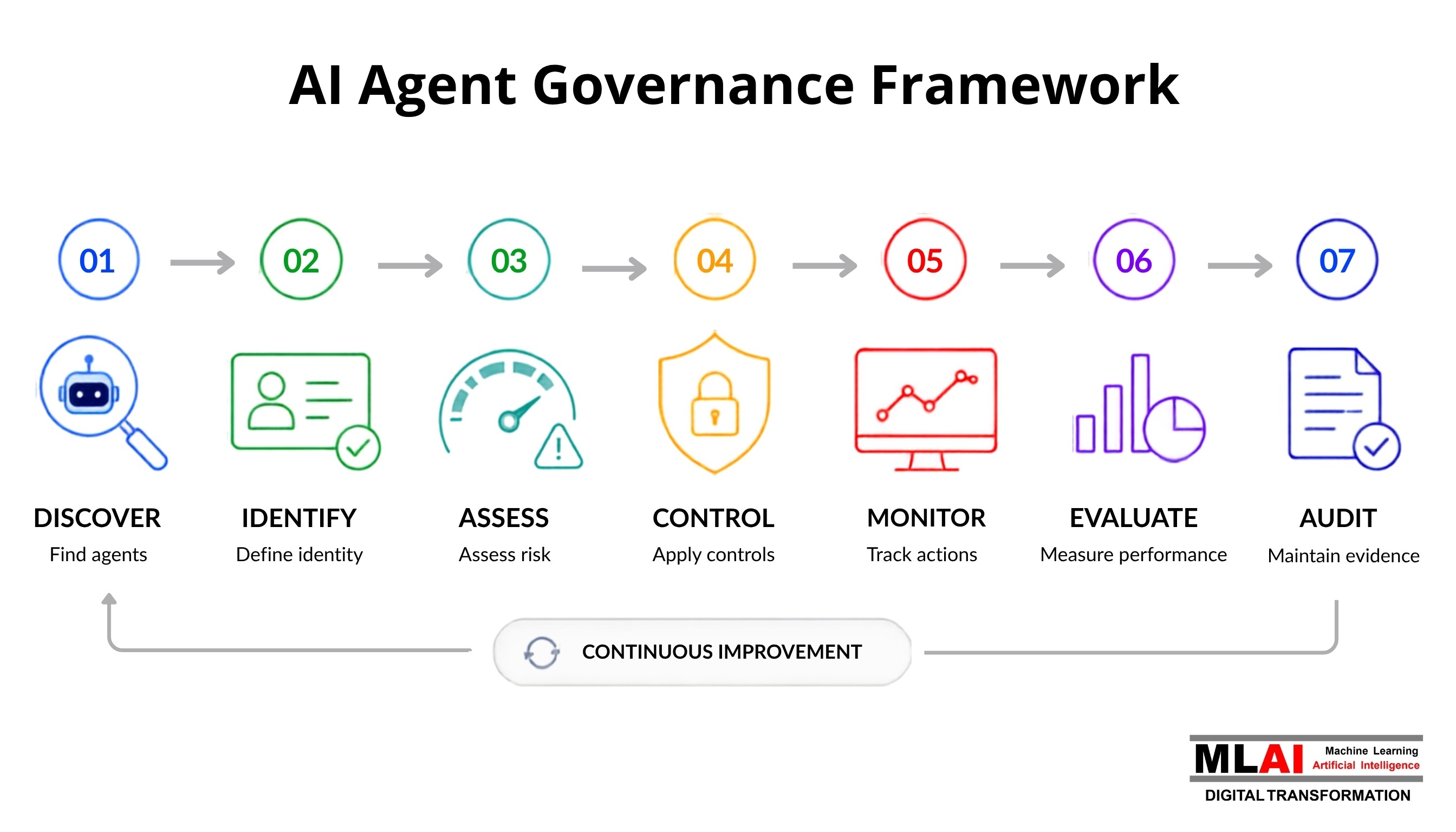
A dependable AI agent governance framework follows a clear lifecycle: Discover → Identify → Assess → Control → Monitor → Evaluate → Audit. Each stage builds on the last, turning governance from a vague aspiration into a repeatable process.
Discover
Start by finding every AI agent operating within the organization, including the ones nobody officially sanctioned. You cannot govern what you haven't found, so discovery comes first. Skip this step and every control you build later will have blind spots you don't even know about.
Identify
For each agent, define its ownership, identity, capabilities, and the tools it connects to. This is where every agent gets a name, a purpose, and a person accountable for it. Documenting what each agent can actually reach also surfaces surprises, like an agent quietly wired into a system it never needed.
Assess
Classify agents based on risk, autonomy, and business impact. A high-risk agent touching customer funds deserves far more scrutiny than one summarizing meeting notes. This ranking is what lets you spend your governance effort where it genuinely matters instead of spreading it evenly and thin.
Control
Apply permissions, policies, and operational guardrails tuned to each agent's risk level. This is governance in action, translating classification into concrete restrictions. The higher the risk, the tighter the controls, so a critical agent runs on a short leash while a harmless one keeps room to move.
Monitor
Track agent behavior, actions, and tool usage continuously. Monitoring turns governance from a one-time setup into a living, breathing safeguard. It's also your early-warning system, catching drift or misbehavior while it's still small enough to correct.
Evaluate
Measure performance, security, and reliability over time. Evaluation tells you whether your controls are working and where they need tightening. Regular review also keeps your governance honest, because an agent that was low-risk last quarter may have taken on far more responsibility since.
Audit
Maintain complete records for accountability and compliance. When a regulator or executive asks what happened, your audit trail answers instantly and credibly. Beyond compliance, those records are invaluable for learning from incidents and proving that your agents did exactly what they were supposed to.
7. How to Secure and Manage AI Agents in Enterprise Workflows
Identity & Access Management
Everything starts with identity. Each agent should authenticate securely, carry a distinct identity, and operate under role-based permissions grounded in least-privilege access. When identity and access are done right, half your risk disappears before it ever materializes. It also means every action can be traced to a specific agent, which is exactly what accountability depends on.
Data Protection
Classify your data, define sensitive data controls, and ensure that every data access is secure and logged. Agents should only reach the data their role justifies, and sensitive categories should carry extra protection by default. Logging every access also gives you a clear trail if you ever need to prove what an agent did and did not see.
Tool & API Governance
Maintain a list of approved integrations, apply action-level permissions, and route high-impact operations through approval of workflows. An agent might be allowed to read from a system but require sign-off before it writes or deletes. This granular approach lets you unlock useful automation without ever handing over the keys to your most sensitive operations.
Runtime Guardrails
Enforce policy at runtime, validate every action before it executes, and hard-block restricted operations. Guardrails that live in the runtime catch problems the moment they occur, not after the damage is done. Because they act on the action itself, they hold up even when an agent is confused, manipulated, or simply wrong.
Monitoring & Observability
Watch agent activity, tool calls, data access, and policy violations in real time, and layer anomaly detection on top. Observability is what lets you spot the unusual before it becomes the catastrophic. It also builds a picture of normal behavior over time, so genuinely odd activity stands out immediately.
Human-in-the-Loop
Build approval workflows, escalation mechanisms, and human override controls for the moments that demand them. The goal isn't to slow agents down everywhere, it's to insert human judgment precisely where it matters most. A well-placed override also gives your team the confidence to grant agents more autonomy, knowing they can always step in.
8. AI Agent Governance in Banking, Insurance & Financial Services
Financial services is where the stakes climb highest, and where governance earns its keep. These are heavily regulated industries handling sensitive data and real money, so ungoverned agents simply aren't an option.
Banking
In banking, agents power fraud detection, automate KYC checks, handle customer service, and drive transaction workflows. Each of these touches money or identity, which means every agent needs tight controls, clear ownership, and airtight audit trails. A single ungoverned agent here isn't just a technical risk, it's a direct line to financial loss and regulatory penalties.
Insurance
Insurers deploy agents across claims processing, underwriting, policy servicing, and document processing. An agent approving or flagging a claim is making a financially consequential decision, so risk-based autonomy and human oversight are essential here. Underwriting decisions in particular can carry fairness and compliance implications, making transparent, auditable governance a must.
Capital Markets
In capital markets, agents assist with investment research, market analysis, and compliance workflows. The speed advantage is enormous, but so is the regulatory exposure, making governance the difference between an edge and a violation. When decisions move at machine speed, guardrails and audit trails are the only way to stay both fast and defensible.
9. How to Implement AI Agent Governance: A Practical 7-Step Roadmap
Rolling out governance doesn't have to be overwhelming. Follow this sequence and you'll build a program that actually holds up.
Create an AI agent inventory. You can't govern what you can't see, so start by cataloging every agent in the organization.
Assign ownership and identity. Give each agent a named owner and a unique identity so accountability is never in doubt.
Classify agents by risk and autonomy. Sort your agents by how much they can do and how much damage they could cause, then govern accordingly.
Define data, tool, and system permissions. Apply least-privilege access across data, tools, and systems so every agent stays in its lane.
Implement guardrails and human approval. Put runtime guardrails and human-in-the-loop checkpoints where the stakes justify them.
Monitor, evaluate, and audit agent behavior. Watch continuously, measure regularly, and keep complete records throughout.
Establish incident response and lifecycle management. Plan for when things go wrong and manage each agent from creation to retirement.
10. Common Mistakes & Best Practices
Common Mistakes
The failures we see most often are surprisingly avoidable. Watch out for these:
Giving agents excessive permissions. Teams grant broad access because it's easier than scoping it properly, turning every agent into a potential single point of failure.
Relying only on prompts for security. Prompts can be manipulated or ignored, so treating them as a real control leaves the door wide open.
Deploying agents without clear ownership. When no one owns an agent, no one is accountable, and problems fall through the cracks.
Treating every agent the same. A low-risk helper and a high-risk actor need very different controls, and one-size-fits-all governance fails both.
Not monitoring agents after deployment. Agents drift and misbehave over time, and without ongoing monitoring you only find out once damage is done.
Ignoring agent-to-agent interactions. As agents start talking to one another, unmonitored pathways let one mistake or breach cascade across the fleet.
Best Practices
The fixes are just as clear. Build these habits in from the start:
Design governance from day one. Bake controls in from the outset rather than bolting them on after agents are already live.
Apply least-privilege access. Give every agent only what its role needs, keeping the blast radius small if anything goes wrong.
Use risk-based controls. Match your governance effort to each agent's exposure so scrutiny lands where it matters most.
Keep humans in high-impact decisions. Insert human judgment at the checkpoints that carry real financial, legal, or reputational weight.
Monitor continuously. Watch agent behavior in real time instead of assuming things are fine after launch.
Maintain audit trails. Keep complete records so you can prove what every agent did, whenever a regulator or executive asks.
Review permissions regularly. An agent's needs change over time, and its access should be tightened or expanded to match.
Conclusion
AI Agent Governance is what turns autonomous AI from a gamble into a genuine business advantage. Throughout this guide, we've seen how governance defines what agents can do, protects sensitive data, enforces least-privilege access, and keeps humans in control of high-stakes decisions. From identifying every agent to auditing its behavior, a strong AI agent governance framework builds the trust, accountability, and operational control that enterprises need to scale safely. In banking, insurance, and beyond, the future of enterprise AI won't be won by whoever moves fastest, but by whoever balances autonomy with security and human oversight. Govern well, and your agents become an asset you can truly rely on.
1. Introduction
AI Agent Governance has quickly become one of the most important conversations in enterprise technology, and it arrived faster than most leadership teams expected. Just a couple of years ago, AI in the enterprise mostly meant a helpful chatbot. Today, AI agents book meetings, move money between systems, query sensitive databases, and make decisions that used to sit on a human's desk. The moment software stops merely suggesting and starts acting, the rules change completely, which is exactly why AI Agent Governance has moved from a nice-to-have to a boardroom priority.
The tension is simple: autonomy is where the value lives, but the same autonomy that makes agents useful also makes them risky. In this guide, we'll cover what AI Agent Governance actually means, why it matters more than ever, the real risks of leaving agents ungoverned, and a practical framework you can put to work, so you can keep innovation moving while staying firmly in control.
2. What Is AI Agent Governance?
At its simplest, AI Agent Governance is the set of policies, controls, and oversight mechanisms that decide what an AI agent is allowed to do, how it does it, and who is accountable when something goes wrong. Think of it as the operating rulebook for your digital workforce, except this workforce never sleeps and can act across dozens of systems at once.
Governance shapes agent behavior in very concrete ways. It defines which data an agent can touch, which tools it can call, how much autonomy it gets, and what happens when it steps outside approved boundaries. Instead of hoping an agent behaves, governance builds the guardrails that make good behavior the default and bad behavior nearly impossible.
It's worth separating a few ideas that often get blurred together. Traditional AI governance was largely about models, focusing on bias, fairness, training data, and explainability. That still matters, but agentic AI governance goes further because agents don't just predict; they act. You now have to govern the actions themselves, not only the outputs.
There's also a difference between governance and AI agent security. Security is about protecting the agent and the systems around it from threats, things like preventing prompt injection or unauthorized access. Governance is the wider umbrella that includes security but also covers ownership, accountability, compliance, and control. As agent autonomy climbs, this distinction stops being academic. The more an agent can do on its own, the more governance becomes the thing standing between a productive automation and an expensive incident.
3. Why Enterprises Need AI Agent Governance
3.1 The Business Challenge
Modern AI agents are deeply woven into the fabric of the enterprise, and that's precisely what makes them powerful and precarious at the same time. These agents routinely reach into enterprise data stores, pulling customer records, financial figures, and internal documents to do their jobs. They connect to business applications and APIs, meaning a single agent might touch your CRM, your payment gateway, and your ticketing system within seconds.
Now layer autonomous decision-making on top of all that. When an agent independently approves a refund, flags a transaction, or routes a claim, it's making choices inside workflows that carry real financial and legal weight. That's a remarkable capability, but without structure around it, it's also a liability waiting to surface.
3.2 Why Governance Is Essential
The case for enterprise AI agent governance really comes down to a handful of hard truths. First, security and privacy protection: agents handle sensitive information, and one careless configuration can expose data you're legally obligated to protect. Second, regulatory compliance, because regulators in banking, insurance, and healthcare are already asking pointed questions about how automated systems make decisions.
Then there's accountability and ownership. When an agent does something wrong, someone has to own that outcome, and "the AI did it" is not an answer any auditor accepts. Governance also solves a scaling problem. One agent is easy to watch; fifty agents spread across departments are not. Managing multiple agents across the organization demands a consistent set of rules rather than a patchwork of one-off decisions. Ultimately, strong governance is how you balance genuine innovation with the operational control that keeps the business safe.
4. Key Risks of Ungoverned AI Agents
4.1 Excessive Access and Permissions
The most common mistake, by far, is handing agents far more access than they actually need. It feels efficient in the moment, but an agent with sweeping permissions becomes a single point of catastrophic failure. If that agent is ever compromised or misfires, the damage isn't contained, it spreads across every system it could reach. Proper AI agent access control keeps every agent boxed into exactly what its role requires and nothing more.
4.2 Data Leakage and Privacy Risks
Agents move data constantly, and every movement is a chance for something sensitive to end up somewhere it shouldn't. An agent might inadvertently include confidential details in a response, log private information, or pass data to a tool that wasn't cleared to receive it. In regulated industries, a single slip like this can trigger breach notifications, fines, and lasting reputational damage.
4.3 Prompt Injection and Manipulation
This is one of the sneakier threats in the agentic world. A malicious instruction buried inside a document, email, or web page can hijack an agent's behavior, tricking it into ignoring its rules. What makes it dangerous is that the agent believes it's following legitimate input, so nothing looks wrong until the harm is already done. Strong AI agent security is the frontline defense against this kind of manipulation.
4.4 Incorrect or Unintended Actions
Agents can misread context and take actions no one intended, sending the wrong email, updating the wrong record, or triggering a process at the wrong time. Because these actions are real, not hypothetical, the consequences land immediately. And unlike a bad prediction that a human can quietly ignore, a wrong action often can't be undone without cost.
4.5 Tool and API Misuse
When an agent has access to powerful tools, it can also misuse them, calling an API too aggressively, invoking a destructive operation, or chaining tools in ways that produce unexpected results. Even without malicious intent, an agent optimizing for a goal can find shortcuts that break things. Action-level permissions and approval gates are what keep that power in check.
4.6 Agent-to-Agent Risks
As organizations deploy multiple agents that talk to one another, new risks emerge. One agent's mistake can cascade into another, and a compromised agent can influence its peers. These interactions are easy to overlook and hard to trace without deliberate oversight. The more agents you connect, the more these hidden pathways multiply, so mapping and monitoring agent-to-agent traffic becomes essential.
4.7 Shadow AI and Unmanaged Agents
Perhaps the scariest category is the agents you don't even know exist. Teams spin up their own agents to solve local problems, and before long there's a shadow fleet operating outside any governance at all, with no owner, no monitoring, and no accountability. Because leadership can't see them, these agents never get patched, reviewed, or retired, which makes them a quiet but growing security gap.
4.8 Compliance and Accountability Risks
Without clear records of what an agent did and why, compliance falls apart. Regulators want traceability, and ungoverned agents simply can't provide it. When an auditor asks who approved a decision or why an action was taken, "we're not sure" is not a defensible answer. This is where disciplined AI agent risk management becomes non-negotiable.
5. The Core Principles of AI Agent Governance
5.1 Agent Identity and Ownership
Every agent needs a clear identity and a named owner, just like every employee does. If you can't say who is responsible for an agent, you can't govern it. Identity is also what lets you trace actions back to a specific agent later, which is the backbone of any audit. It's the foundation everything else is built on.
5.2 Least-Privilege Access
Give each agent the minimum access it needs to do its job, and not a byte more. Least-privilege isn't a limitation on capability, it's a limitation on blast radius when something goes wrong. Even if an agent is breached or behaves unexpectedly, tight scoping ensures it can only touch a small, controlled slice of your environment.
5.3 Risk-Based Autonomy
Not every agent deserves the same freedom. A low-stakes agent that drafts internal summaries can operate loosely, while an agent that moves money should be tightly leashed. Match autonomy to risk, always. This way you avoid smothering harmless agents in red tape while still keeping a firm grip on the ones that could cause real damage.
5.4 Human Oversight
For high-impact decisions, keep a human in the loop. Oversight doesn't mean micromanaging every action, it means designing checkpoints where human judgment steps in exactly when the stakes justify it. Done well, it feels less like a bottleneck and more like a safety net that only appears when it's truly needed.
5.5 Data Governance
Control which data agents can access, classify that data by sensitivity, and enforce those classifications at runtime. Good data governance is what stops an agent from ever seeing what it shouldn't. It also means that when data does need protecting, the rules travel with it automatically rather than depending on each agent to behave.
5.6 Guardrails and Policy Enforcement
Guardrails are the rules that hold even when an agent tries to cross them. Rather than trusting an agent to behave, you enforce policies at the system level so violations are blocked automatically. This is the difference between a suggestion the agent might ignore and a hard boundary it physically cannot cross.
5.7 Monitoring and Auditability
You can't govern what you can't see. Continuous monitoring and complete audit trails give you both real-time awareness and the historical record you'll need when questions arise later. Together they turn governance from a hopeful policy into something you can actually prove, both to your own leadership and to any regulator who asks.
6. AI Agent Governance Framework
A dependable AI agent governance framework follows a clear lifecycle: Discover → Identify → Assess → Control → Monitor → Evaluate → Audit. Each stage builds on the last, turning governance from a vague aspiration into a repeatable process.
Discover
Start by finding every AI agent operating within the organization, including the ones nobody officially sanctioned. You cannot govern what you haven't found, so discovery comes first. Skip this step and every control you build later will have blind spots you don't even know about.
Identify
For each agent, define its ownership, identity, capabilities, and the tools it connects to. This is where every agent gets a name, a purpose, and a person accountable for it. Documenting what each agent can actually reach also surfaces surprises, like an agent quietly wired into a system it never needed.
Assess
Classify agents based on risk, autonomy, and business impact. A high-risk agent touching customer funds deserves far more scrutiny than one summarizing meeting notes. This ranking is what lets you spend your governance effort where it genuinely matters instead of spreading it evenly and thin.
Control
Apply permissions, policies, and operational guardrails tuned to each agent's risk level. This is governance in action, translating classification into concrete restrictions. The higher the risk, the tighter the controls, so a critical agent runs on a short leash while a harmless one keeps room to move.
Monitor
Track agent behavior, actions, and tool usage continuously. Monitoring turns governance from a one-time setup into a living, breathing safeguard. It's also your early-warning system, catching drift or misbehavior while it's still small enough to correct.
Evaluate
Measure performance, security, and reliability over time. Evaluation tells you whether your controls are working and where they need tightening. Regular review also keeps your governance honest, because an agent that was low-risk last quarter may have taken on far more responsibility since.
Audit
Maintain complete records for accountability and compliance. When a regulator or executive asks what happened, your audit trail answers instantly and credibly. Beyond compliance, those records are invaluable for learning from incidents and proving that your agents did exactly what they were supposed to.
7. How to Secure and Manage AI Agents in Enterprise Workflows
Identity & Access Management
Everything starts with identity. Each agent should authenticate securely, carry a distinct identity, and operate under role-based permissions grounded in least-privilege access. When identity and access are done right, half your risk disappears before it ever materializes. It also means every action can be traced to a specific agent, which is exactly what accountability depends on.
Data Protection
Classify your data, define sensitive data controls, and ensure that every data access is secure and logged. Agents should only reach the data their role justifies, and sensitive categories should carry extra protection by default. Logging every access also gives you a clear trail if you ever need to prove what an agent did and did not see.
Tool & API Governance
Maintain a list of approved integrations, apply action-level permissions, and route high-impact operations through approval of workflows. An agent might be allowed to read from a system but require sign-off before it writes or deletes. This granular approach lets you unlock useful automation without ever handing over the keys to your most sensitive operations.
Runtime Guardrails
Enforce policy at runtime, validate every action before it executes, and hard-block restricted operations. Guardrails that live in the runtime catch problems the moment they occur, not after the damage is done. Because they act on the action itself, they hold up even when an agent is confused, manipulated, or simply wrong.
Monitoring & Observability
Watch agent activity, tool calls, data access, and policy violations in real time, and layer anomaly detection on top. Observability is what lets you spot the unusual before it becomes the catastrophic. It also builds a picture of normal behavior over time, so genuinely odd activity stands out immediately.
Human-in-the-Loop
Build approval workflows, escalation mechanisms, and human override controls for the moments that demand them. The goal isn't to slow agents down everywhere, it's to insert human judgment precisely where it matters most. A well-placed override also gives your team the confidence to grant agents more autonomy, knowing they can always step in.
8. AI Agent Governance in Banking, Insurance & Financial Services
Financial services is where the stakes climb highest, and where governance earns its keep. These are heavily regulated industries handling sensitive data and real money, so ungoverned agents simply aren't an option.
Banking
In banking, agents power fraud detection, automate KYC checks, handle customer service, and drive transaction workflows. Each of these touches money or identity, which means every agent needs tight controls, clear ownership, and airtight audit trails. A single ungoverned agent here isn't just a technical risk, it's a direct line to financial loss and regulatory penalties.
Insurance
Insurers deploy agents across claims processing, underwriting, policy servicing, and document processing. An agent approving or flagging a claim is making a financially consequential decision, so risk-based autonomy and human oversight are essential here. Underwriting decisions in particular can carry fairness and compliance implications, making transparent, auditable governance a must.
Capital Markets
In capital markets, agents assist with investment research, market analysis, and compliance workflows. The speed advantage is enormous, but so is the regulatory exposure, making governance the difference between an edge and a violation. When decisions move at machine speed, guardrails and audit trails are the only way to stay both fast and defensible.
9. How to Implement AI Agent Governance: A Practical 7-Step Roadmap
Rolling out governance doesn't have to be overwhelming. Follow this sequence and you'll build a program that actually holds up.
Create an AI agent inventory. You can't govern what you can't see, so start by cataloging every agent in the organization.
Assign ownership and identity. Give each agent a named owner and a unique identity so accountability is never in doubt.
Classify agents by risk and autonomy. Sort your agents by how much they can do and how much damage they could cause, then govern accordingly.
Define data, tool, and system permissions. Apply least-privilege access across data, tools, and systems so every agent stays in its lane.
Implement guardrails and human approval. Put runtime guardrails and human-in-the-loop checkpoints where the stakes justify them.
Monitor, evaluate, and audit agent behavior. Watch continuously, measure regularly, and keep complete records throughout.
Establish incident response and lifecycle management. Plan for when things go wrong and manage each agent from creation to retirement.
10. Common Mistakes & Best Practices
Common Mistakes
The failures we see most often are surprisingly avoidable. Watch out for these:
Giving agents excessive permissions. Teams grant broad access because it's easier than scoping it properly, turning every agent into a potential single point of failure.
Relying only on prompts for security. Prompts can be manipulated or ignored, so treating them as a real control leaves the door wide open.
Deploying agents without clear ownership. When no one owns an agent, no one is accountable, and problems fall through the cracks.
Treating every agent the same. A low-risk helper and a high-risk actor need very different controls, and one-size-fits-all governance fails both.
Not monitoring agents after deployment. Agents drift and misbehave over time, and without ongoing monitoring you only find out once damage is done.
Ignoring agent-to-agent interactions. As agents start talking to one another, unmonitored pathways let one mistake or breach cascade across the fleet.
Best Practices
The fixes are just as clear. Build these habits in from the start:
Design governance from day one. Bake controls in from the outset rather than bolting them on after agents are already live.
Apply least-privilege access. Give every agent only what its role needs, keeping the blast radius small if anything goes wrong.
Use risk-based controls. Match your governance effort to each agent's exposure so scrutiny lands where it matters most.
Keep humans in high-impact decisions. Insert human judgment at the checkpoints that carry real financial, legal, or reputational weight.
Monitor continuously. Watch agent behavior in real time instead of assuming things are fine after launch.
Maintain audit trails. Keep complete records so you can prove what every agent did, whenever a regulator or executive asks.
Review permissions regularly. An agent's needs change over time, and its access should be tightened or expanded to match.
Conclusion
AI Agent Governance is what turns autonomous AI from a gamble into a genuine business advantage. Throughout this guide, we've seen how governance defines what agents can do, protects sensitive data, enforces least-privilege access, and keeps humans in control of high-stakes decisions. From identifying every agent to auditing its behavior, a strong AI agent governance framework builds the trust, accountability, and operational control that enterprises need to scale safely. In banking, insurance, and beyond, the future of enterprise AI won't be won by whoever moves fastest, but by whoever balances autonomy with security and human oversight. Govern well, and your agents become an asset you can truly rely on.
Related Blogs
Be the first to read our articles.

