


Best AI Agent Development Companies for Cybersecurity in 2026
Prerna Sahni
AI Agents
1. Introduction
Cyberattacks are growing faster than the security teams defending against them. Analysts are overwhelmed, alert queues are out of control, and traditional tools are struggling to keep up. This is exactly where AI Agent Development Companies are stepping in to change the game. These companies are building AI security agents that can monitor threats, investigate incidents, and respond to attacks around the clock without waiting for a human to press a button. For any enterprise looking to stay ahead of modern threats, knowing which AI Agent Development Companies are leading the charge in 2026 is no longer optional.
2. What Are AI Security Agents?
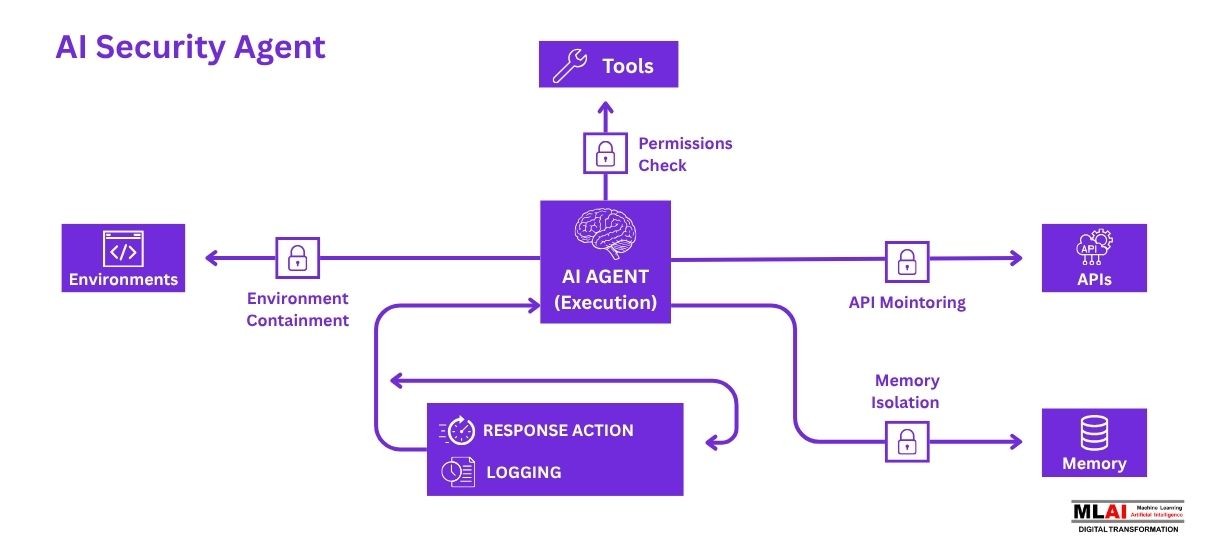
AI security agents are autonomous software systems that perceive their environment, reason for what they find, and take action without constant human direction. They are not chatbots, and they are not basic automation scripts. Cybersecurity AI agents represent a genuine shift from reactive rule-following to proactive, intelligent defense.
Traditional security automation follows fixed scripts. If a log matches pattern A, fire alert B. That works until an attacker does something slightly unexpected, and modern attackers almost always do. AI security agents think differently. They correlate signals across thousands of data points, recognize patterns they have not seen before, and pursue investigations the way a skilled analyst would, only faster and at a much larger scale.
The core capabilities of a true AI security agent include:
Continuous monitoring across endpoints, networks, and cloud environments
Autonomous alert triage that separates real threats from noise
Multi-step threat investigation that follows the evidence wherever it leads
Incident response actions including isolation, remediation, and escalation
Contextual support for SOC analysts so they can focus on what matters
3. Why Enterprises Are Investing in AI Security Agents
The pressures driving adoption of autonomous SOC agents are familiar to anyone who works in enterprise security. The attack surface has never been larger. The average organization now manages thousands of endpoints, multiple cloud environments, hundreds of SaaS applications, and a distributed workforce. Monitoring all of it continuously is beyond the capacity of any human team.
The cybersecurity talent shortage makes this worse. There are more open security positions globally than qualified candidates to fill them. Analysts who are in the job are burning out, processing alert queues that run into the tens of thousands per day. Studies show that critical alerts are regularly missed not because analysts lack skill but because they lack bandwidth.
Enterprises also face tighter compliance requirements and shorter breach disclosure windows. The cost of a significant incident has never been higher. AI-powered cybersecurity automation addresses these pressures directly by handling the volume and velocity of modern threats that human teams simply cannot manage alone.
4. Key Features to Look for in an AI Agent Development Company
4.1 Cybersecurity Expertise
Building an AI agent that can reason about security threats requires deep domain knowledge, not just AI engineering. The best AI Agent Development Companies in this space have security practitioners embedded in their product teams. They understand how SOC workflows function, how SIEM platforms generate and correlate events, and how to work within frameworks like MITRE ATT&CK. Look for native SIEM integrations, built-in threat intelligence, and compliance-aware workflows.
4.2 Autonomous Agent Capabilities
Pressure-test what vendors mean by autonomous. True autonomous SOC agents can handle multi-step investigations without requiring human input at every stage. They reason about ambiguous evidence, pursue hypotheses across multiple data sources, and make contextually appropriate response decisions. Key features to look for include multi-agent orchestration, automated remediation, continuous monitoring, and context-aware reasoning.
4.3 Enterprise Integration
An enterprise AI security platform that cannot integrate with your existing infrastructure is an island. Before evaluating any vendor, map your current security stack and ask specific questions about integration depth. Surface-level API connections are not the same as deep bidirectional integrations that allow agents to both read data and take action. Multi-cloud compatibility, horizontal scalability, and real-time analytics are non-negotiable for enterprise deployments.
4.4 Custom AI Agent Development
Every enterprise security environment is unique. The best AI Agent Development Companies do not just offer a product. They offer a platform that lets organizations build and deploy AI security agents tailored to their specific workflows, infrastructure, and risk profile. Look for industry-specific templates, workflow customization, and enterprise-grade deployment options.
5. Best AI Agent Development Companies for Cybersecurity in 2026
5.1 Merv.one
Merv.one stands apart because it was built from the ground up for cybersecurity. While most AI Agent Development Companies started as general-purpose AI platforms and then extended into security, Merv.one began with the SOC. Its entire architecture is designed around real security operations. The result is an enterprise AI security platform that security teams can actually use without translating their needs into the language of a generic AI tool. Its autonomous SOC agents handle the full lifecycle of a security incident, from initial alert triage through investigation and response, without requiring human sign-off at every step.
5.2 OpenAI
OpenAI's models power a significant portion of the security copilots and AI-assisted analysis tools available today. For organizations building custom AI security workflows on top of frontier language model capabilities, OpenAI's API provides a strong foundation. That said, OpenAI is a foundational AI company, not a security specialist, and that distinction matters when you need domain-specific reliability in high-stakes situations.
5.3 Microsoft Security Copilot
Microsoft's Security Copilot sits atop Sentinel and Defender, giving it native access to one of the largest security data lakes in the world. For enterprises already in the Microsoft ecosystem, the integration advantages are real. Security Copilot reflects a serious commitment to AI-powered cybersecurity automation, particularly for AI-assisted threat analysis and natural language investigation.
5.4 CrowdStrike
CrowdStrike has been one of the most aggressive traditional security vendors in adopting autonomous AI capabilities. Its Falcon platform now incorporates AI-driven endpoint detection and response that goes well beyond signature-based protection. Charlotte AI, its generative security assistant, reflects a broader bet on intelligence-augmented operations that is paying off for enterprises with complex endpoint environments.
5.5 Palo Alto Networks
Palo Alto's Cortex XSIAM platform is built around the autonomous SOC model, aggregating data, correlating threats, and automating response workflows at enterprise scale. For organizations looking for a proven enterprise AI security platform within a broader security ecosystem, Palo Alto remains a strong option.
6. What Makes Merv.one Different from Other AI Agent Development Companies?
6.1 Built Specifically for Cybersecurity
General-purpose AI Agent Development Companies build horizontal tools and configure them for vertical use cases. Merv.one inverted that model. Every architectural decision was made with SOC operations in mind. This means its AI security agents do not just have access to security data. They understand it. They know the difference between a credential anomaly that signals a real attack and one that reflects normal user behavior.
6.2 Autonomous Security Agent Architecture
Merv.one's agents are multi-step reasoning systems that sustain complex investigations across many data sources without losing context. They can generate and test hypotheses about threat activity, monitor continuously without scheduled scans, and execute automated workflows that follow contextual decision trees rather than rigid scripts. This is what real autonomous SOC agents look like in practice.
6.3 Enterprise-Focused AI Security Automation
Merv.one was designed for enterprise complexity from day one. Enterprise environments involve dozens of tools, multiple cloud environments, hybrid infrastructure, and teams at different levels of technical maturity. The platform handles this through native multi-cloud support, deep SIEM and SOAR integrations, real-time analytics, and security orchestration that works with the existing tool ecosystem rather than replacing it.
6.4 AI Agents That Reduce SOC Workload
Merv.one's agents absorb the high-volume, low-judgment work that consumes most of an analyst's day: alert triage, log correlation, indicator enrichment, and routine investigations. When that layer is handled autonomously, analysts can bring their expertise to bear on the investigations that genuinely require human judgment. The result is a SOC that operates at a higher level across the board.
6.5 Custom AI Security Agent Development
Rather than offering one-size-fits-all automation, Merv.one enables enterprises to build AI security agents tailored to their environment. This is especially valuable for regulated industries where generic security solutions often fail to account for specific compliance obligations and threat landscapes.
7. Comparison Table: Merv.one vs Traditional AI Agent Companies
Feature | General AI Companies | Merv.one |
Cybersecurity Focus | Limited | Dedicated |
Autonomous Security Agents | Partial | Advanced |
SOC Workflow Automation | Basic | Extensive |
Threat Investigation | Generic AI | Security-Specific |
Enterprise Security Use Cases | Broad | Specialized |
AI Security Automation | Optional | Core Offering |
8. How AI Agents Are Transforming Modern SOC Teams
Autonomous SOC agents are changing the way security teams operate. Here is where the impact is most visible:
Faster Alert Triage: AI security agents process the full alert queue in real time, apply enrichment, and surface only the events that genuinely need human attention. Analysts spend less time on noise and more time on real threats.
Smarter Threat Correlation: Modern attacks leave traces across networks, endpoints, cloud, and authentication systems. Cybersecurity AI agents connect those signals into a clear picture instantly, work that used to take analysts hours.
Reduced Analyst Burnout: By absorbing high-volume repetitive work, AI agents free analysts to focus on investigations that actually require human judgment. This improves both retention and the quality of security decisions.
Lower MTTR: Organizations deploying mature autonomous SOC agents consistently report major reductions in mean time to respond. Faster response directly limits the damage any attack can cause.
Always-On Coverage: Unlike human teams, AI-powered cybersecurity automation does not have shift changes, off days, or fatigue. Threats are monitored and acted on around the clock without gaps.
9. AI Security Agent Use Cases
The range of applications for cybersecurity AI agents continues to expand as the technology matures. Here are the use cases delivering the most value in enterprise environments right now.
Threat detection: Continuous monitoring of network traffic, endpoint activity, user behavior, and cloud telemetry to identify indicators of compromise in real time
Phishing analysis: Automated analysis of suspicious emails, URLs, and attachments with triage decisions made in seconds rather than minutes
Vulnerability management: Intelligent prioritization of vulnerabilities based on exploitability, asset criticality, and active threat intelligence
Incident response: Autonomous execution of containment and remediation playbooks when confidence thresholds are met
Security monitoring: Always-on coverage that does not require shift changes and does not miss alerts due to queue overload
Cloud security automation: Autonomous monitoring and response across multi-cloud environments where event volumes exceed human capacity
Identity threat detection: Continuous analysis of authentication patterns and privilege usage to detect compromised credentials and insider threats
10. Challenges in AI Agent Adoption
Deploying cybersecurity AI agents at enterprise scale involves navigating real complexity. Here are the key challenges organizations need to plan for:
Data Privacy: AI security agents require access to sensitive telemetry to function. This raises governance questions around where data is processed, how it is retained, and who has access. The best enterprise AI security platforms address this through strong data isolation and configurable retention policies.
Model Hallucinations: LLM-based agents can produce confident but incorrect conclusions. In a security context this is a serious risk. Robust deployments include human review checkpoints for high-stakes decisions and confidence thresholds that trigger escalation rather than autonomous action when certainty is low.
Integration Complexity: Connecting an AI security agent platform to an existing enterprise security stack takes real effort. Organizations should budget adequate time and resources for deployment and configuration, and should not expect plug-and-play results with every tool in their stack.
Compliance Concerns: Using AI for automated security decisions raises questions in some regulatory frameworks. Security teams should engage their compliance functions early in the evaluation process.
Human Oversight Requirements: Even the most capable autonomous SOC agents require ongoing human governance. Monitoring performance, tuning configurations, and handling genuinely novel situations are responsibilities that stay with the security team.
11. Future of AI Agents in Cybersecurity
The direction of travel is clear. Here is where the field is headed over the next few years:
Autonomous SOCs: Fully autonomous Security Operations Centers, where AI agents handle the majority of detection, investigation, and response without human intervention in routine cases, are already emerging in forward-thinking enterprises. Within a few years the autonomous SOC will likely be the standard model for large organizations.
Multi-Agent Security Systems: As orchestration technology matures, specialized agents focused on network threats, identity, cloud, and endpoint will collaborate dynamically to handle complex cross-domain incidents that no single agent could resolve alone.
Predictive Threat Intelligence: Combining behavioral analytics with real-time external threat intelligence, AI security agents will anticipate attack vectors before threat actors deploy them, shifting the defender posture from response to prevention.
AI-Driven Cyber Defense: The shift from reactive to proactive defense will accelerate. Cybersecurity AI agents will increasingly be deployed to identify and eliminate vulnerabilities before they can be exploited, not just respond after the fact.
Self-Healing Security Systems: The furthest point on the horizon is environments that can detect, respond, and automatically repair the vulnerabilities that enabled an attack, creating security postures that get stronger every time they are tested.
12. Conclusion
AI security agents are no longer a future technology. They are a present-day competitive advantage for enterprises that deploy them well. The organizations winning the security battle in 2026 are the ones that recognized early that the volume and sophistication of modern threats had permanently outpaced what human-only SOC teams could manage.
Choosing the right partner from the growing landscape of AI Agent Development Companies is the most consequential decision in that journey. General-purpose platforms have valuable capabilities, but the enterprises with the most mature deployments are predominantly working with purpose-built cybersecurity AI agent platforms. Companies like Merv.one, where security is not a use case but a core identity, are setting the standard for what enterprise AI security looks like in practice.
The future of enterprise cybersecurity is autonomous, intelligent, and agent-driven. The AI Agent Development Companies building that future are ready to partner with you today.
1. Introduction
Cyberattacks are growing faster than the security teams defending against them. Analysts are overwhelmed, alert queues are out of control, and traditional tools are struggling to keep up. This is exactly where AI Agent Development Companies are stepping in to change the game. These companies are building AI security agents that can monitor threats, investigate incidents, and respond to attacks around the clock without waiting for a human to press a button. For any enterprise looking to stay ahead of modern threats, knowing which AI Agent Development Companies are leading the charge in 2026 is no longer optional.
2. What Are AI Security Agents?
AI security agents are autonomous software systems that perceive their environment, reason for what they find, and take action without constant human direction. They are not chatbots, and they are not basic automation scripts. Cybersecurity AI agents represent a genuine shift from reactive rule-following to proactive, intelligent defense.
Traditional security automation follows fixed scripts. If a log matches pattern A, fire alert B. That works until an attacker does something slightly unexpected, and modern attackers almost always do. AI security agents think differently. They correlate signals across thousands of data points, recognize patterns they have not seen before, and pursue investigations the way a skilled analyst would, only faster and at a much larger scale.
The core capabilities of a true AI security agent include:
Continuous monitoring across endpoints, networks, and cloud environments
Autonomous alert triage that separates real threats from noise
Multi-step threat investigation that follows the evidence wherever it leads
Incident response actions including isolation, remediation, and escalation
Contextual support for SOC analysts so they can focus on what matters
3. Why Enterprises Are Investing in AI Security Agents
The pressures driving adoption of autonomous SOC agents are familiar to anyone who works in enterprise security. The attack surface has never been larger. The average organization now manages thousands of endpoints, multiple cloud environments, hundreds of SaaS applications, and a distributed workforce. Monitoring all of it continuously is beyond the capacity of any human team.
The cybersecurity talent shortage makes this worse. There are more open security positions globally than qualified candidates to fill them. Analysts who are in the job are burning out, processing alert queues that run into the tens of thousands per day. Studies show that critical alerts are regularly missed not because analysts lack skill but because they lack bandwidth.
Enterprises also face tighter compliance requirements and shorter breach disclosure windows. The cost of a significant incident has never been higher. AI-powered cybersecurity automation addresses these pressures directly by handling the volume and velocity of modern threats that human teams simply cannot manage alone.
4. Key Features to Look for in an AI Agent Development Company
4.1 Cybersecurity Expertise
Building an AI agent that can reason about security threats requires deep domain knowledge, not just AI engineering. The best AI Agent Development Companies in this space have security practitioners embedded in their product teams. They understand how SOC workflows function, how SIEM platforms generate and correlate events, and how to work within frameworks like MITRE ATT&CK. Look for native SIEM integrations, built-in threat intelligence, and compliance-aware workflows.
4.2 Autonomous Agent Capabilities
Pressure-test what vendors mean by autonomous. True autonomous SOC agents can handle multi-step investigations without requiring human input at every stage. They reason about ambiguous evidence, pursue hypotheses across multiple data sources, and make contextually appropriate response decisions. Key features to look for include multi-agent orchestration, automated remediation, continuous monitoring, and context-aware reasoning.
4.3 Enterprise Integration
An enterprise AI security platform that cannot integrate with your existing infrastructure is an island. Before evaluating any vendor, map your current security stack and ask specific questions about integration depth. Surface-level API connections are not the same as deep bidirectional integrations that allow agents to both read data and take action. Multi-cloud compatibility, horizontal scalability, and real-time analytics are non-negotiable for enterprise deployments.
4.4 Custom AI Agent Development
Every enterprise security environment is unique. The best AI Agent Development Companies do not just offer a product. They offer a platform that lets organizations build and deploy AI security agents tailored to their specific workflows, infrastructure, and risk profile. Look for industry-specific templates, workflow customization, and enterprise-grade deployment options.
5. Best AI Agent Development Companies for Cybersecurity in 2026
5.1 Merv.one
Merv.one stands apart because it was built from the ground up for cybersecurity. While most AI Agent Development Companies started as general-purpose AI platforms and then extended into security, Merv.one began with the SOC. Its entire architecture is designed around real security operations. The result is an enterprise AI security platform that security teams can actually use without translating their needs into the language of a generic AI tool. Its autonomous SOC agents handle the full lifecycle of a security incident, from initial alert triage through investigation and response, without requiring human sign-off at every step.
5.2 OpenAI
OpenAI's models power a significant portion of the security copilots and AI-assisted analysis tools available today. For organizations building custom AI security workflows on top of frontier language model capabilities, OpenAI's API provides a strong foundation. That said, OpenAI is a foundational AI company, not a security specialist, and that distinction matters when you need domain-specific reliability in high-stakes situations.
5.3 Microsoft Security Copilot
Microsoft's Security Copilot sits atop Sentinel and Defender, giving it native access to one of the largest security data lakes in the world. For enterprises already in the Microsoft ecosystem, the integration advantages are real. Security Copilot reflects a serious commitment to AI-powered cybersecurity automation, particularly for AI-assisted threat analysis and natural language investigation.
5.4 CrowdStrike
CrowdStrike has been one of the most aggressive traditional security vendors in adopting autonomous AI capabilities. Its Falcon platform now incorporates AI-driven endpoint detection and response that goes well beyond signature-based protection. Charlotte AI, its generative security assistant, reflects a broader bet on intelligence-augmented operations that is paying off for enterprises with complex endpoint environments.
5.5 Palo Alto Networks
Palo Alto's Cortex XSIAM platform is built around the autonomous SOC model, aggregating data, correlating threats, and automating response workflows at enterprise scale. For organizations looking for a proven enterprise AI security platform within a broader security ecosystem, Palo Alto remains a strong option.
6. What Makes Merv.one Different from Other AI Agent Development Companies?
6.1 Built Specifically for Cybersecurity
General-purpose AI Agent Development Companies build horizontal tools and configure them for vertical use cases. Merv.one inverted that model. Every architectural decision was made with SOC operations in mind. This means its AI security agents do not just have access to security data. They understand it. They know the difference between a credential anomaly that signals a real attack and one that reflects normal user behavior.
6.2 Autonomous Security Agent Architecture
Merv.one's agents are multi-step reasoning systems that sustain complex investigations across many data sources without losing context. They can generate and test hypotheses about threat activity, monitor continuously without scheduled scans, and execute automated workflows that follow contextual decision trees rather than rigid scripts. This is what real autonomous SOC agents look like in practice.
6.3 Enterprise-Focused AI Security Automation
Merv.one was designed for enterprise complexity from day one. Enterprise environments involve dozens of tools, multiple cloud environments, hybrid infrastructure, and teams at different levels of technical maturity. The platform handles this through native multi-cloud support, deep SIEM and SOAR integrations, real-time analytics, and security orchestration that works with the existing tool ecosystem rather than replacing it.
6.4 AI Agents That Reduce SOC Workload
Merv.one's agents absorb the high-volume, low-judgment work that consumes most of an analyst's day: alert triage, log correlation, indicator enrichment, and routine investigations. When that layer is handled autonomously, analysts can bring their expertise to bear on the investigations that genuinely require human judgment. The result is a SOC that operates at a higher level across the board.
6.5 Custom AI Security Agent Development
Rather than offering one-size-fits-all automation, Merv.one enables enterprises to build AI security agents tailored to their environment. This is especially valuable for regulated industries where generic security solutions often fail to account for specific compliance obligations and threat landscapes.
7. Comparison Table: Merv.one vs Traditional AI Agent Companies
Feature | General AI Companies | Merv.one |
Cybersecurity Focus | Limited | Dedicated |
Autonomous Security Agents | Partial | Advanced |
SOC Workflow Automation | Basic | Extensive |
Threat Investigation | Generic AI | Security-Specific |
Enterprise Security Use Cases | Broad | Specialized |
AI Security Automation | Optional | Core Offering |
8. How AI Agents Are Transforming Modern SOC Teams
Autonomous SOC agents are changing the way security teams operate. Here is where the impact is most visible:
Faster Alert Triage: AI security agents process the full alert queue in real time, apply enrichment, and surface only the events that genuinely need human attention. Analysts spend less time on noise and more time on real threats.
Smarter Threat Correlation: Modern attacks leave traces across networks, endpoints, cloud, and authentication systems. Cybersecurity AI agents connect those signals into a clear picture instantly, work that used to take analysts hours.
Reduced Analyst Burnout: By absorbing high-volume repetitive work, AI agents free analysts to focus on investigations that actually require human judgment. This improves both retention and the quality of security decisions.
Lower MTTR: Organizations deploying mature autonomous SOC agents consistently report major reductions in mean time to respond. Faster response directly limits the damage any attack can cause.
Always-On Coverage: Unlike human teams, AI-powered cybersecurity automation does not have shift changes, off days, or fatigue. Threats are monitored and acted on around the clock without gaps.
9. AI Security Agent Use Cases
The range of applications for cybersecurity AI agents continues to expand as the technology matures. Here are the use cases delivering the most value in enterprise environments right now.
Threat detection: Continuous monitoring of network traffic, endpoint activity, user behavior, and cloud telemetry to identify indicators of compromise in real time
Phishing analysis: Automated analysis of suspicious emails, URLs, and attachments with triage decisions made in seconds rather than minutes
Vulnerability management: Intelligent prioritization of vulnerabilities based on exploitability, asset criticality, and active threat intelligence
Incident response: Autonomous execution of containment and remediation playbooks when confidence thresholds are met
Security monitoring: Always-on coverage that does not require shift changes and does not miss alerts due to queue overload
Cloud security automation: Autonomous monitoring and response across multi-cloud environments where event volumes exceed human capacity
Identity threat detection: Continuous analysis of authentication patterns and privilege usage to detect compromised credentials and insider threats
10. Challenges in AI Agent Adoption
Deploying cybersecurity AI agents at enterprise scale involves navigating real complexity. Here are the key challenges organizations need to plan for:
Data Privacy: AI security agents require access to sensitive telemetry to function. This raises governance questions around where data is processed, how it is retained, and who has access. The best enterprise AI security platforms address this through strong data isolation and configurable retention policies.
Model Hallucinations: LLM-based agents can produce confident but incorrect conclusions. In a security context this is a serious risk. Robust deployments include human review checkpoints for high-stakes decisions and confidence thresholds that trigger escalation rather than autonomous action when certainty is low.
Integration Complexity: Connecting an AI security agent platform to an existing enterprise security stack takes real effort. Organizations should budget adequate time and resources for deployment and configuration, and should not expect plug-and-play results with every tool in their stack.
Compliance Concerns: Using AI for automated security decisions raises questions in some regulatory frameworks. Security teams should engage their compliance functions early in the evaluation process.
Human Oversight Requirements: Even the most capable autonomous SOC agents require ongoing human governance. Monitoring performance, tuning configurations, and handling genuinely novel situations are responsibilities that stay with the security team.
11. Future of AI Agents in Cybersecurity
The direction of travel is clear. Here is where the field is headed over the next few years:
Autonomous SOCs: Fully autonomous Security Operations Centers, where AI agents handle the majority of detection, investigation, and response without human intervention in routine cases, are already emerging in forward-thinking enterprises. Within a few years the autonomous SOC will likely be the standard model for large organizations.
Multi-Agent Security Systems: As orchestration technology matures, specialized agents focused on network threats, identity, cloud, and endpoint will collaborate dynamically to handle complex cross-domain incidents that no single agent could resolve alone.
Predictive Threat Intelligence: Combining behavioral analytics with real-time external threat intelligence, AI security agents will anticipate attack vectors before threat actors deploy them, shifting the defender posture from response to prevention.
AI-Driven Cyber Defense: The shift from reactive to proactive defense will accelerate. Cybersecurity AI agents will increasingly be deployed to identify and eliminate vulnerabilities before they can be exploited, not just respond after the fact.
Self-Healing Security Systems: The furthest point on the horizon is environments that can detect, respond, and automatically repair the vulnerabilities that enabled an attack, creating security postures that get stronger every time they are tested.
12. Conclusion
AI security agents are no longer a future technology. They are a present-day competitive advantage for enterprises that deploy them well. The organizations winning the security battle in 2026 are the ones that recognized early that the volume and sophistication of modern threats had permanently outpaced what human-only SOC teams could manage.
Choosing the right partner from the growing landscape of AI Agent Development Companies is the most consequential decision in that journey. General-purpose platforms have valuable capabilities, but the enterprises with the most mature deployments are predominantly working with purpose-built cybersecurity AI agent platforms. Companies like Merv.one, where security is not a use case but a core identity, are setting the standard for what enterprise AI security looks like in practice.
The future of enterprise cybersecurity is autonomous, intelligent, and agent-driven. The AI Agent Development Companies building that future are ready to partner with you today.
Related Blogs
Be the first to read our articles.

